Showing posts with label research. Show all posts
Showing posts with label research. Show all posts
Wednesday, January 13, 2016
Eric P. Newman Graduate Seminar in Numismatics at the American Numismatic Society
The American Numismatic Society has announced its next Eric P. Newman Graduate Seminar in Numismatics, June 6 to July 29, 2016. Applicants should apply by February 12. Anyone wishing to support the seminar through a donation may do so here.
Wednesday, December 16, 2015
The XVIth International Numismatic Congress in Warsaw, 2021
At the XVth International Numismatic Congress in Taormina Sicily in September of this year, delegates voted to confirm Warsaw, Poland as the venue for XVIth Congress in 2021. The distinguished numismatist Aleksander Bursche is organizing the XVIth Congress.
Poland has a long history as a center of numismatic scholarship as summarized by the promotional video presented at the XVth Congress. It is available here and below.
Poland has a long history as a center of numismatic scholarship as summarized by the promotional video presented at the XVth Congress. It is available here and below.
Wednesday, December 9, 2015
SAFE Founder Receives AIA's 2016 Outstanding Public Service Award
Congratulations to Cindy Ho, founder of Saving Antiquities for Everyone (SAFE), who will receive the 2016 Outstanding Public Service Award from the Archaeological Institute of America.
I became aware of SAFE back in 2007 when I began research on the illicit antiquities trade in response to some of the bizarre arguments I saw repeatedly deployed to defend it. Cindy was very encouraging of those early explorations . Cindy has done a great deal to raise popular awareness of the looting problem and is thus well-deserving of this distinction. As she might say, looting is not just a loss to archaeology and historical study, but it constitutes a loss to us all. The AIA's citation for Cindy's award states "For her prominent and dedicated work to raise public awareness of the need to safeguard archaeological heritage."
I became aware of SAFE back in 2007 when I began research on the illicit antiquities trade in response to some of the bizarre arguments I saw repeatedly deployed to defend it. Cindy was very encouraging of those early explorations . Cindy has done a great deal to raise popular awareness of the looting problem and is thus well-deserving of this distinction. As she might say, looting is not just a loss to archaeology and historical study, but it constitutes a loss to us all. The AIA's citation for Cindy's award states "For her prominent and dedicated work to raise public awareness of the need to safeguard archaeological heritage."
Friday, October 2, 2015
XVth International Numismatic Congress - Taormina, Sicily
I am still fighting jet lag from my recent trip to Italy where, among other things, I participated in the XVth International Numismatic Congress in Taormina, Sicily from 21-25 September. It was great to have my paper scheduled in the first session on the first day of the Congress so that the pressure was off and I could better enjoy talking to old colleagues, meeting new friends, and hearing about all the great research going on in numismatics.
The Congress happens once every six years and so it is a major event. There were approximately 700 attendees, over 400 of whom also delivered papers. Maria Caltabiano and Mariangela Puglisi are owed praise for the organization of the Congress.
The time in Sicily at the Congress was spectacular and there is too much to summarize in detail, although there were a few highlights for me.
On the first day I picked up the Survey of Numismatic Research and the Congress Medal (that will now sit alongside my medal from the 2009 Congress in Glasgow; here's my summary of that Congress - the time has flown by!). The Survey is a monumental work and I enjoyed reading the entries on Roman numismatics as well as Dan Pett's "Numismatics, Computers and the Internet." Some colleagues, Maria Cristina Molinari and Cristian Gazdac, generously gave me copies of their recent books. I also picked up a few books on Roman coin iconography of which I had been unaware until I saw them in the exhibit hall.
In addition to the full academic program, there are numerous social events, receptions, and meals at the Congresses. The ANS held a reception in honor of BCD and in memory of Richard Witschonke, both of whom were the honorands of books containing essays on Greek and Roman numismatics, respectively. I got to take home my copy of P.G. van Alfen, G. Bransbourg, and M. Amandry (eds.), Fides: Contributions to Numismatics in Honor of Richard B. Witschonke. (New York: American Numismatic Society, 2015). Rick read drafts of the essays prior to his passing. He was always a generous, affable, and humble colleague and his presence at the Congress was sorely missed by all who knew him.
On the last evening was the social dinner, which for me was the last opportunity to speak with friends and colleagues before we all went our separate ways the next day.
Meeting new people and meeting people whose work you have read before is always one of the most exciting things at the Congress; there was, of course, much opportunity for this. I was happy to meet many new people and several established numismatists as well rising starts in the field. I regularly read the Coins Weekly newsletter and it was also great to meet the people who run that operation at their booth at the Congress. They recently summarized their experiences at the Congress as well.
The Congress was certainly a worthwhile event and if you missed this one, I recommend the next one. The next Congress will be in Warsaw in 2021; it will be organized by Aleksander Bursche. I look forward to seeing everyone again then, but hopefully also before then.
The Congress happens once every six years and so it is a major event. There were approximately 700 attendees, over 400 of whom also delivered papers. Maria Caltabiano and Mariangela Puglisi are owed praise for the organization of the Congress.
The time in Sicily at the Congress was spectacular and there is too much to summarize in detail, although there were a few highlights for me.
On the first day I picked up the Survey of Numismatic Research and the Congress Medal (that will now sit alongside my medal from the 2009 Congress in Glasgow; here's my summary of that Congress - the time has flown by!). The Survey is a monumental work and I enjoyed reading the entries on Roman numismatics as well as Dan Pett's "Numismatics, Computers and the Internet." Some colleagues, Maria Cristina Molinari and Cristian Gazdac, generously gave me copies of their recent books. I also picked up a few books on Roman coin iconography of which I had been unaware until I saw them in the exhibit hall.
In addition to the full academic program, there are numerous social events, receptions, and meals at the Congresses. The ANS held a reception in honor of BCD and in memory of Richard Witschonke, both of whom were the honorands of books containing essays on Greek and Roman numismatics, respectively. I got to take home my copy of P.G. van Alfen, G. Bransbourg, and M. Amandry (eds.), Fides: Contributions to Numismatics in Honor of Richard B. Witschonke. (New York: American Numismatic Society, 2015). Rick read drafts of the essays prior to his passing. He was always a generous, affable, and humble colleague and his presence at the Congress was sorely missed by all who knew him.
On the last evening was the social dinner, which for me was the last opportunity to speak with friends and colleagues before we all went our separate ways the next day.
 |
| Social Dinner. From right to left: Ethan Grueber (ANS), David Hill (ANS), Elena Stolyarik (ANS), Me (Baylor), Andrew McCabe (Independent Scholar/Collector), David Hendin (ANS), and I'm sorry that I cannot remember the names of the three people on the other side of the table whom I met for the first time at the dinner. (© MünzenWoche/CoinsWeekly). |
Meeting new people and meeting people whose work you have read before is always one of the most exciting things at the Congress; there was, of course, much opportunity for this. I was happy to meet many new people and several established numismatists as well rising starts in the field. I regularly read the Coins Weekly newsletter and it was also great to meet the people who run that operation at their booth at the Congress. They recently summarized their experiences at the Congress as well.
 | ||
| Ursula Kampmann took pictures with each of Coins Weekly's readers who stopped by the booth. (© MünzenWoche/Coins Weekly). |
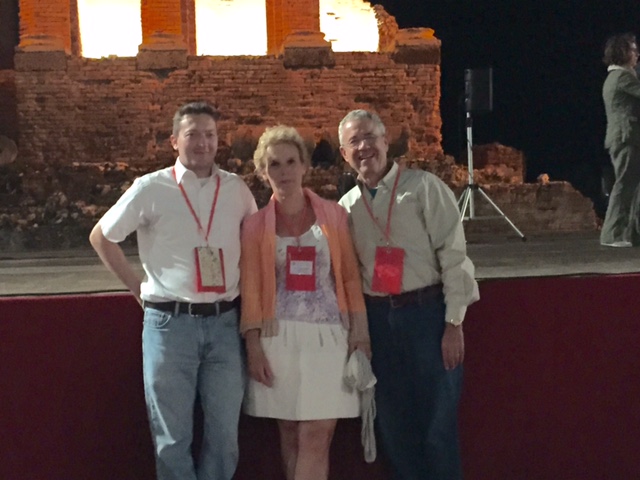 |
| From left: Me, Ute Wartenberg-Kagan (ANS), David Hendin (ANS), standing in front of the scaenae frons of the theater at Taormina. |
Wednesday, August 19, 2015
'Art in the Round': New Approaches to Ancient Coin Iconography
 In November 2012 an international workshop, 'Art in the Round': New Approaches to Ancient Coin Iconography, was held at the Eberhard-Karls-Universität Tübingen. At the end of 2014, the proceedings of that workshop were published: Elkins, N.T. and S. Krmnicek (eds.), 'Art in the Round': New Approaches to Ancient Coin Iconography. Tübinger Archäologische Forschungen 16. (Rahden: Verlag Marie Leidorf, 2014). Most participants were able to publish in the proceedings. Contributions explore different methods and approaches to ancient coin iconography and come from emerging and established scholars alike (Table of Contents here).
Permission was granted by the publisher to place the book's introduction online, which is available here and provides some description of the essays that follow. A kind summary of the book's contents was recently provided also by Dr. Ursula Kampmann of Coins Weekly.
Sunday, July 5, 2015
Shepard Fairey and Roman Art
Aside from one upper-level course in Greek or Roman art history per semester, I also teach the Art History survey sequence: Prehistory to Medieval Art in the fall and Renaissance to Contemporary Art in the spring. Even though my specialty is Antiquity, I find the second half of the survey is somehow more enjoyable to teach. Maybe it is because I am not as "close" to it and can allow myself to have more fun with the subject when teaching. One of my favorite artists to teach in the second half of the survey is Shepard Fairey, whose art I have also recently begun to collect. I find the students also enjoy learning about him as they recognize his work in popular culture and wear Obey shirts (they are often thrilled to learn what Obey on their shirts is about as many don't already know). As I work in a department driven primarily by a studio art program, a significant number of my survey students are graphic design majors. One of the many hats that Shepard Fairey wears is that of a graphic designer; that is perhaps another reason the students enjoy seeing Fairey's work as he is an artist who has foot in both fine art and design.
So what does the Shepard Fairey, of Obey Giant fame, who received worldwide recognition for his iconic "Hope" poster of Senator Obama during the 2008 primary - now one of the most famous and parodied images of the early 21st century, - have to do with Roman art? Nothing really, except that my own work on Roman imperial art and coinage may explain why this contemporary artist and his artwork resonate with me. I explain below.
Much of Fairey's work, especially his signed and numbered serigraphs are relatively affordable; they sell from roughly $45-$65 on his website if you can get them immediately as they are released. The price point is intentional as Fairey wants his fans to be able to afford his work. Older prints, or ones that you miss during a release, are available for a markup in the secondhand market. The rarity of and demand for the print in question dictates the degree of that markup. Over the past year, I have begun collecting Shepard Fairey's serigraphs and have thus far acquired eight prints and many books about his art. I plan to continue to grow the collection. Two of these prints are quite rare and historical: "Progress" from 2008 (edition of 350), which contained the same iconic image as "Hope" print/poster, of which half a million posters were printed. The "Progress" preceded that iconic, nearly identical, "Hope" image. After the release of "Progress", the campaign adopted the image, asking Fairey to use the word "Hope" instead as a campaign poster. As an art historian and archaeologist, the historic and documentary
quality of the "Progress" piece particularly appealed to me. It is an original print of one of the most recognizable images of the early 21st century, a part of our contemporary popular culture. The other print, "War:
Everyone Wants It" from 2003 (edition of 200) is biting critique of the
Iraq War, begun in 2003, through both image and text. Although both are rare
and desirable prints among collectors, I think I was able to acquire both of these
historical pieces at reasonable prices - an important consideration for an academic.
For one recent acquisition, I was lucky to
have beaten the notorious "eBay flippers," who purchase Fairey prints
and immediately put them on eBay for two or three times the purchase
price, and buy directly from Obey:
"Pay Up or Shut Up" (2015, signed and numbered edition of 450). This print depicts Uncle Sam's hand - his identity evident from the patriotic decoration on the sleeve of his suit - covering the mouth of a gentleman in a suit and tie, thereby silencing him. At the top left, the text reads "All the Free Speech Money Can Buy." At the lower right of the image is the Obey Giant logo and the title "Pay Up or Shut Up." The print critiques the Citizens United supreme court decisions regarding Super PACs and donors to them. The effect of this, as Fairey and others have described it, is the equation of money with speech and influence as politicians benefiting from wealthy PACsand donors will be unduly influenced by corporate and commercial interests. The combination of text image points out the need for campaign finance reform to maintain legitimate democracy. The sloganeering and fonts recall American 1950s-era advertisements that seem innocent enough on the surface, but from a 21st-century perspective many of these old advertisements smacked of racism or sexism, or cutely peddled dangerous products, such as cigarettes.
Beyond mid-20th advertisements, Fairey's work clearly draws influence and inspiration from multiple artists, movements, and popular art media. Perusing through a gallery of his works, one readily observes the influence of Social Realism, and especially Socialist Realism, in many of his pieces. As a politically-minded artist, Fairey uses the visual cues of Socialist Realist imagery, accompanied by clearly ironical or satirical slogans, to point out dangerous flaws in contemporary American democracy that potentially corrode our democracy (I think he would say they do corrode that democracy) and put us on a path to autocracy and oligarchy, and/or corporatocracy. Other works use the same visual style to exalt certain figures, such as freedom fighters and advocates for peace such as Aung San Suu Kyi. One recent piece deploying the style of Socialist Realism is "Farewell to Freedom" (signed and numbered edition of 500), an homage to comedian and political-news satirist Stephen Colbert of the recently-ended Colbert Report. The slogan was also that of Colbert's last show. Stephen Colbert asked Shepard Fairey, previously a guest on the Report as well as a guest on the last show, to design the image for his final episode; signed and numbered prints were also released on the Obey Giant website. In this example, the imagery seems to me to provide Colbert-inspired satire
while the text may reflect Fairey's sentiment. Stephen, using the American flag as a cape, stands to the
left in a three quarter pose, one leg striding forward with his foot
resting upon a globe; he does not engage the viewer but looks up
confidently as if a resolute and transcendent figure (not unlike
portraits of Alexander the great with the dramatically twisted neck
and upturned eyes - a feature curiously enough observable in the
"Hope"/"Progress" image). In his right hand he wields a sword and in
his left he holds a round shield - not dissimilar to Captain America's
shield - as an eagle soars in the background. The image of Stephen Colbert as a sort of authoritarian, transcendent, and god-like individual draws upon historical images of monarchs and from Socialist Realism, but parodies them. On the Colbert Report, Stephen's unbreakable persona of the consummate egoist and fiercely uncompromising politically partisan pundit sharply satirized political news-show hosts on 24-hour cable-news networks. The image, therefore, was a fitting tribute to the persona Stephen Colbert had adopted. The text, "Farewell to Freedom," used in jest by the Colbert Report, reinforced the humorous notion that the political pundits on 24-hour cable-news networks actively present themselves as patriotic defenders of democracy who drape their one-sided opinions in the flag; Colbert's departure from the show thus signifies a certain "end" to freedom. Nonetheless, the "Farewell to Freedom" print perhaps conveys something more sentimental in that Stephen Colbert's biting satire, but strong substance, was perceived by the artist and by many others as more honest and penetrating than that of the news-channel pundits that his show skewered.
Even though Fairey is generally unpopular among political conservatives, he, like Stephen Colbert, criticizes both Republicans and Democrats, looking beyond partisanship to examine the function and dysfunction of the organs of American democracy itself, and American society more broadly; he has criticized President Obama several times since the election (a recent example here). While one might disagree with Fairey's position on certain issues, those literate in art ought to to appreciate his work. I mean "appreciate" in the sense of what "art appreciation" means (i.e., there is a difference between liking it on the one hand and appreciating/understanding it on the other). Fairey's art and its sharp indictments of the political establishment are not only activist statements themselves, but also are reflective of broader popular disappointment and discontentment with how the contemporary American political system and landscape has (d)evolved over the past couple of decades. A 2010 print, "These Parties Disgust Me," criticizes the flawed two-party system, frustration with both major political parties, and the artist's sentiment that campaign finance reform may be an antidote.
What appeals to me about Fairey's work is the conscious propagandist quality of his work. With text and image, and often in the style of an advertisement or Socialist Realist political posters, he directly takes on an issue to make a point, often challenging policies espoused, or even ignored, by the news media. One might see his work as propaganda to counter propaganda. Indeed, "Worldwide Propaganda Delivery" is an Obey Giant slogan. The Obey sticker campaign sought to make one aware of his environment and the things he sees (and perhaps hears); the Obey logo, visible on his works, imbues his art with a sense of the looming authoritarian and, in so doing, reminds the viewer to question and critically evaluate everything.
Now for the connection with Roman art, which attracts to me to Fairey's work, as I study the communicative aspects of Roman imperial art and especially the coinage. Roman imperial art has often been described as "propaganda," although few historians of Roman art would use that description today as carelessly as we have in the past. Propaganda has strong 20th-century connotations. Immediately one may recall the imagery and messages disseminated by the authoritarian governments of Soviet Russia and Nazi Germany via highly organized and well-structured propaganda ministries. The goal of propaganda is to persuade the people of the government's position or course of action and to garner their support. Roman art was not propaganda in this sense. First of all, the Roman state was nowhere near this organized in the dissemination of messages. Secondly, the Roman emperor, although a monarch, was not the sort of absolutist dictatorial ruler as that of modern North Korea or of Nazi Germany. Instead, the head of the Roman state maintained power by negotiating and cultivating positive symbiotic relationships with many important constituencies in the Roman Empire: the Senate, the plebs urbana, the armies and their commanders, and provincial elites. Finally, state-sanctioned Roman imperial art was not formulated to persuade imperial subjects of the emperor's political agenda with the goal of changing attitudes.
What state-sanctioned imperial art did was to present the emperor in a positive light. In many cases, official state-sanctioned images, as appeared on the coinage, may not have been formulated by the imperial court at all. A prominent theory is that mint officials formulated the images and messages on the coins with the emperor foremost in mind as the primary audience. In this scenario, much of Roman art was akin to contemporary poetry and panegyric which aggrandized and honored the emperor. Indeed, contemporary imperial coinage and text often reflected the same ideals, indicating that they reflected the political rhetoric of the day. Even if the goal of much of the official art and coinage was to flatter the emperor, it also was seen, used, and experienced by viewers throughout the Roman world and so the communicative aspects of art and coinage ought not to be dismissed even though it was not "propaganda" in our typical understanding of the world. One of the best and most recent discussions of the differences between the modern word "propaganda" and the communicative aspects of Roman imperial art that I have read is in Carlos Noreña's, Imperial Ideals in the Roman West (Cambridge University Press, 2011), pp. 15-21. On p. 18, Noreña makes reference to another scholar (Ellul) who distinguished between "agitation" and "integration" propaganda. He summarizes as follows.
I am well aware that at this stage I have only a perfunctory knowledge of this artist's work, but I plan to continue to learn.
So what does the Shepard Fairey, of Obey Giant fame, who received worldwide recognition for his iconic "Hope" poster of Senator Obama during the 2008 primary - now one of the most famous and parodied images of the early 21st century, - have to do with Roman art? Nothing really, except that my own work on Roman imperial art and coinage may explain why this contemporary artist and his artwork resonate with me. I explain below.
 |
| Shepard Fairey, Hope, 2008, preceded by Progress, 2008. |
 |
| Shepard Fairey, Pay Up or Shut Up, 2015. |
 | ||
| Shepard Fairey, Farewell to Freedom, 2014. |
 |
| Shepard Fairey, These Parties Disgust Me, 2010. |
What appeals to me about Fairey's work is the conscious propagandist quality of his work. With text and image, and often in the style of an advertisement or Socialist Realist political posters, he directly takes on an issue to make a point, often challenging policies espoused, or even ignored, by the news media. One might see his work as propaganda to counter propaganda. Indeed, "Worldwide Propaganda Delivery" is an Obey Giant slogan. The Obey sticker campaign sought to make one aware of his environment and the things he sees (and perhaps hears); the Obey logo, visible on his works, imbues his art with a sense of the looming authoritarian and, in so doing, reminds the viewer to question and critically evaluate everything.
Now for the connection with Roman art, which attracts to me to Fairey's work, as I study the communicative aspects of Roman imperial art and especially the coinage. Roman imperial art has often been described as "propaganda," although few historians of Roman art would use that description today as carelessly as we have in the past. Propaganda has strong 20th-century connotations. Immediately one may recall the imagery and messages disseminated by the authoritarian governments of Soviet Russia and Nazi Germany via highly organized and well-structured propaganda ministries. The goal of propaganda is to persuade the people of the government's position or course of action and to garner their support. Roman art was not propaganda in this sense. First of all, the Roman state was nowhere near this organized in the dissemination of messages. Secondly, the Roman emperor, although a monarch, was not the sort of absolutist dictatorial ruler as that of modern North Korea or of Nazi Germany. Instead, the head of the Roman state maintained power by negotiating and cultivating positive symbiotic relationships with many important constituencies in the Roman Empire: the Senate, the plebs urbana, the armies and their commanders, and provincial elites. Finally, state-sanctioned Roman imperial art was not formulated to persuade imperial subjects of the emperor's political agenda with the goal of changing attitudes.
What state-sanctioned imperial art did was to present the emperor in a positive light. In many cases, official state-sanctioned images, as appeared on the coinage, may not have been formulated by the imperial court at all. A prominent theory is that mint officials formulated the images and messages on the coins with the emperor foremost in mind as the primary audience. In this scenario, much of Roman art was akin to contemporary poetry and panegyric which aggrandized and honored the emperor. Indeed, contemporary imperial coinage and text often reflected the same ideals, indicating that they reflected the political rhetoric of the day. Even if the goal of much of the official art and coinage was to flatter the emperor, it also was seen, used, and experienced by viewers throughout the Roman world and so the communicative aspects of art and coinage ought not to be dismissed even though it was not "propaganda" in our typical understanding of the world. One of the best and most recent discussions of the differences between the modern word "propaganda" and the communicative aspects of Roman imperial art that I have read is in Carlos Noreña's, Imperial Ideals in the Roman West (Cambridge University Press, 2011), pp. 15-21. On p. 18, Noreña makes reference to another scholar (Ellul) who distinguished between "agitation" and "integration" propaganda. He summarizes as follows.
Generally speaking, Fairey's prints in the early 2000s and today exhibit the sort of dissent that is hardly observable in Roman art. Fairey understands his own work as a sort of propaganda, borrowing directly from propagandist media, such as Socialist Realist posters, to make his points. One might then see his work as "agitation propaganda" as it seeks to make the viewer aware of problems with the official state-sanctioned narrative. He exhibits what we seldom have record of in the Roman visual arts: resistance and reaction to the contemporary political rhetoric and culture. Fairey also has a following who hold the same beliefs and values that he does and some of his pieces might also be seen as a sort of "integration propaganda" to which the official Roman imperial art media might have been more related; it would probably be a like-minded individual who would consume something like "Pay Up or Shut Up" or "Farewell to Freedom." Although the signed and numbered prints are limited, he often makes unsigned and unnumbered pasters, like the "Hope" poster in 2008, that can be used to saturate the public with a message. Like the imperial coinage, in which certain ideals were reinforced consistently over time, Fairey has also reinforced ideals and concepts through time, such as campaign finance reform; this has been a theme in much of his work for several years now. What draws me intellectually to the study of Roman art and coinage is the fact that they are historical monuments that tell us about the regime's politics and ideals at a moment in time long ago. They represent pictorially the way that the regime conceived of itself and projected itself (either in a direct or indirect way). While having the feel of an official medium, Fairey's art is anti-establishment and criticizes perceived problems in our present democracy through autocratic and commercial imagery and styles. Fairey makes art for the living, as the Romans did, but he advocates for progressive change and points out issues that potentially could compromise democracy or otherwise degrade our society. But as the years pass, his work will, like those Roman objects, become the realm of history. We or our successors will have the opportunity to see if his concerns were valid. Some of his work has unquestionably already entered that historical realm."While agitation propaganda seeks to change attitudes, according to Ellul's definition, integration propaganda seeks to bolster them. The former is more visible and widespread, is often subversive, and bears 'the stamp of opposition,' while the latter aims instead at 'stabilizing the social body,' making it 'the preferred instrument of government.' This distinction is useful, and helps to explain why the imperial regime ever bothered to communicate a set of ideals and values associated with the reigning emperor. In general, there was not much in the way of agitation propaganda in the Roman imperial period. During the high empire in particular, there was little need to change attitudes and - even more important - the actual mechanics of imperial communications would have made it almost impossible to do so. That the regular, long-term dissemination of imperial ideals was instead intended, at least in part, to reinforce belief in the legitimacy of Roman imperial rule seems more plausible....But the official communication of imperial ideals by the central state necessarily entailed a positive valuation of imperial rule, which in turn entailed a degree of persuasion, even if only implicit. Moreover, one of the media available to the imperial regime, the coinage, was particularly well suited to the slow, long-term diffusion of ideas upon which such integration propaganda depends. As a preliminary conclusion, then, we may see the central state in idealizing the figure of the emperor through a set of ideals and values associated with him, was motivated at least in part by the goal of reinforcing the legitimacy of Roman imperial rule."
I am well aware that at this stage I have only a perfunctory knowledge of this artist's work, but I plan to continue to learn.
Friday, June 13, 2014
International Conference: Currency between Cultures
The international conference Currency between Cultures will be held at the University of Warwick on July 3, 2014.
Further information and registration is available here.
Though money is often characterised as an impersonal medium of exchange, it remains intricately connected to cultural value systems, social relationships, and political regimes. These characteristics are linked to the role of currency as a medium of commensuration designed to render equivalent and transitive once incomparable objects, ideas, signs, and meanings. In this way money goes ‘between’ cultures, and as a medium at the point of contact, money can often become ideologically charged. The eurozone, the rise of alternative currencies like Bitcoin, and the symbolic transformation of currencies during events like the Occupy movement ("We need a Revolution"), indicate that the social, ideological, and political aspects of money remain key modern concerns. This interdisciplinary conference aims to explore the differing ways money has connected, subverted, and entangled different cultures throughout history.
Further information and registration is available here.
Tuesday, May 27, 2014
New Research on Roman Republican Coinage
On June 19-21 in Dresden, Germany, an international colloquium on the topic of New Research on Roma Republican Coinage will be held. Many experts on Roman Republican coinage will present. In order of presentation, speakers include Andrew Burnett, Pierluigi Debernardi, Karl-Joachim Hölkeskamp, Maria Cristina Molinari, Pierre Assenmaker, Reinhard Wolters, David Biedermann, Bernhard Woytek, Florian Haymann, Wilhelm Hollstein, Clare Rowan, Martin Jehne, François de Callataÿ, Elio Lo Cascio, and Fleur Kemmers.
For the program with details for the venue and the subjects to be presented, click here.
For the program with details for the venue and the subjects to be presented, click here.
Saturday, May 17, 2014
The CCPIA and the Circulation of Coins and Other Ancient Objects
The dealer lobby is irritated that people who have expertise on ancient coins have written in favor of a potential MOU with Egypt. One commentator and dealer is outright resentful that any specialist should support an MOU and goes so far as pronounce that the protection of coins in the MOUs is "extralegal."
The Convention on Cultural Property Implementation Act (CCPIA) mandates that protected objects be "first discovered in" the State Party. From the point-of-view of the dealer lobby, coins should not be protected since they circulated. They demand that it be proved beyond a doubt that each individual coin coming into the United States was found in a particular State Party, a task made nearly impossible when a coin is dug up, smuggled, cleaned, and sold by a dealer. The act of looting and smuggling destroys this information.
The dealer lobby asserts that coins are a special case since they "circulated widely" and are "common." But are they such an exception? Some coins circulated very widely and some circulated on a more local or regional level. Apart from static monuments, many ancient objects, in addition to coins, moved around to greater and lesser degrees. Ceramics are a prime example; they could circulate widely and they are "common." Even local wares are sometimes found far afield, although the majority are found locally. These, like circulating coins, are a testament to trade, economic conditions, and the movement of peoples and populations. The Etruscans were avid consumers of Greek painted pottery. The MOU with Italy protects Attic and Corinthian painted ceramics since these are frequently found in Etruscan tombs, even though they were made in Greece and can be found in other countries as well.
With Egyptian coins, the dealer lobby is reasserting the notion that coins "circulated widely" and should not be protected because they could be found anywhere. Yes, there are examples of Egyptian coins found outside of Egypt, but Egyptian coins are found primarily in Egypt. In contesting the potential protection of Egyptian coins, the desperation of their argument is apparent as they refuse to acknowledge long-standing scholarship on ancient Egyptian coins and Egypt's closed currency system, which caused Egypt to retain much of its currency in antiquity.
One commentator points to the Portable Antiquities Scheme database as evidence that Egyptian coins can be found as far away as England. Interestingly, what he does not acknowledge is that the majority of these are late Roman bronze coins from the mint of Alexandria; late Roman bronze coins have not been included in any MOUs thus far as they circulated widely and certainly they were not the subject of any comments sent to the Cultural Property Advisory Committee by advocates for the protection of coins. Again, that commentator refuses to acknowledge the closed currency system in Egypt and the fact that the majority of Egyptian coins will have been found in Egypt, just as a great many Attic and Corinthian ceramics will be found in Italy.
Finally, the protection of coins is extralegal only in the dealer lobby's opinion. Thus far, the lobby has been unsuccessful in undermining import restrictions in the courts. In fact, import restrictions on coins have been upheld by the courts as legal. In fact, the federal district court wrote:
Indeed, it would. And business as usual in the antiquities trade seems to be the intent behind the strategy.
Update, 517/2014: One lobbyist now insists that scholarly evidence cannot be produced that Egyptian coins are found in Egypt. I do look forward to a book from the lawyer/lobbyist that subverts decades of archaeological and numismatic understanding Egypt's closed currency system.
And apparently lobbyists/lawyers can declare what is legal and what is not - forget the courts. But I do not remember it working that way in civics class in grade school...
The Convention on Cultural Property Implementation Act (CCPIA) mandates that protected objects be "first discovered in" the State Party. From the point-of-view of the dealer lobby, coins should not be protected since they circulated. They demand that it be proved beyond a doubt that each individual coin coming into the United States was found in a particular State Party, a task made nearly impossible when a coin is dug up, smuggled, cleaned, and sold by a dealer. The act of looting and smuggling destroys this information.
The dealer lobby asserts that coins are a special case since they "circulated widely" and are "common." But are they such an exception? Some coins circulated very widely and some circulated on a more local or regional level. Apart from static monuments, many ancient objects, in addition to coins, moved around to greater and lesser degrees. Ceramics are a prime example; they could circulate widely and they are "common." Even local wares are sometimes found far afield, although the majority are found locally. These, like circulating coins, are a testament to trade, economic conditions, and the movement of peoples and populations. The Etruscans were avid consumers of Greek painted pottery. The MOU with Italy protects Attic and Corinthian painted ceramics since these are frequently found in Etruscan tombs, even though they were made in Greece and can be found in other countries as well.
With Egyptian coins, the dealer lobby is reasserting the notion that coins "circulated widely" and should not be protected because they could be found anywhere. Yes, there are examples of Egyptian coins found outside of Egypt, but Egyptian coins are found primarily in Egypt. In contesting the potential protection of Egyptian coins, the desperation of their argument is apparent as they refuse to acknowledge long-standing scholarship on ancient Egyptian coins and Egypt's closed currency system, which caused Egypt to retain much of its currency in antiquity.
One commentator points to the Portable Antiquities Scheme database as evidence that Egyptian coins can be found as far away as England. Interestingly, what he does not acknowledge is that the majority of these are late Roman bronze coins from the mint of Alexandria; late Roman bronze coins have not been included in any MOUs thus far as they circulated widely and certainly they were not the subject of any comments sent to the Cultural Property Advisory Committee by advocates for the protection of coins. Again, that commentator refuses to acknowledge the closed currency system in Egypt and the fact that the majority of Egyptian coins will have been found in Egypt, just as a great many Attic and Corinthian ceramics will be found in Italy.
Finally, the protection of coins is extralegal only in the dealer lobby's opinion. Thus far, the lobby has been unsuccessful in undermining import restrictions in the courts. In fact, import restrictions on coins have been upheld by the courts as legal. In fact, the federal district court wrote:
“[I]nterpreting the ‘first discovered in’ requirement to preclude the State Department from barring the importation of archaeological objects with unknown find spots would undermine the core purpose of the CPIA, namely to deter looting of cultural property. See 19 U.S.C. § 2602(a)(1)(A)” (p. 35)."The court further notes that the “ACCG’s argument, if taken to its logical conclusion, could bring into question the import restrictions on every, or almost every, item on the designated lists" (p. 36).
Indeed, it would. And business as usual in the antiquities trade seems to be the intent behind the strategy.
Update, 517/2014: One lobbyist now insists that scholarly evidence cannot be produced that Egyptian coins are found in Egypt. I do look forward to a book from the lawyer/lobbyist that subverts decades of archaeological and numismatic understanding Egypt's closed currency system.
And apparently lobbyists/lawyers can declare what is legal and what is not - forget the courts. But I do not remember it working that way in civics class in grade school...


Monday, May 12, 2014
Open-Access Publications (Numismatic, etc.) from the American School of Classical Studies at Athens
I have just heard from a colleague at the American School of Classical Studies at Athens that the publications committee recently voted to place ASCSA's out-of-print monographs on the Athenian Agora, Corinth, and the Hesperia supplements on its website. The publications have been made freely available in consultation with JSTOR, which provided the scans.
Some important references on coin finds in Greece are included and have been placed online.
Some important references on coin finds in Greece are included and have been placed online.
- Thompson, M. 1954. The Athenian Agora II: Coins from the Roman through the Venetian Period. (Princeton: The American School of Classical Studies at Athens).
- Miles, G.C. 1962. The Athenian Agora IX: The Islamic Coins. (Princeton: The American School of Classical Studies at Athens).
- Kroll, J. 1993. The Athenian Agora XXVI: The Greek Coins. (Princeton: The American School of Classical Studies at Athens).
- Edwards, K.M. 1933. Corinth VI: Coins, 1826-1929. (Princeton: The American School of Classical Studies at Athens).
Saturday, January 18, 2014
Conference: Currencies between Cultures
The University of Warwick has announced a conference entitled "Currencies between Cultures" to be held July 3, 2014. More information can be found here.
Tuesday, February 26, 2013
Huqoq 2013
The staff are gearing up for another season at Huqoq and the field school student applications are in. The 2012 season was most successful. What will 2013 hold for Huqoq Excavation Project?
The Baby and The Bathwater
Ever the provocateur, paid trade lobbyist Peter Tompa excels at the art of finding subjects to spin and snipe, even the most benign. The post here from February 17, 2013 summarizes an international conference on ancient coin iconography held last fall. Tompa muses ("Tail Wags Dog"):
The study of ancient coin iconography can be worked at multiple angles. Yes. So?
Anyone who read the summary or announcement of the workshop that was posted here should have understood that exploring the various ways that coin iconography can be approached was the whole point of the workshop. Tompa, it seems, would have us discard the importance of archaeological context simply because there are other ways that coin iconography can be studied too. If we are playing with tired idioms, forget about "tail wagging dog," Tompa would have us "throw out the baby with the bathwater"!
Tompa boldly claims "But all the workshop topics about coin iconography (including one Elkins himself chaired) simply belie this claim." Why the deception? Why ignore the fact that the workshop did include a session on "Coin Iconography in Numismatic and Material Contexts"? In case the session title is not clear, some papers in that session approached the study of coin iconography through the lens of find contexts (i.e. material context). For further clarification this means through hoards and/or archaeological excavation.
Coin iconography is, of course, not only worked at via find context and cannot be approached through material context alone, but to ignore its place in the workshop to promote one's own agenda is surely dishonest. And to imply that coin iconography cannot be approached through this route displays an ignorance of recent peer-reviewed research by several specialists on coin iconography that has appeared in-print within the last 5-10 years. The subject of Roman coin iconography is especially fruitful; our understanding of Roman imperial communication via the coins continues to be enhanced by attention to archaeological context.
It is simply wrong-headed to suggest that just because there are other ways of approaching subjects that other methods are irrelevant. We can read ancient historical texts that have survived the ages. Does that mean the study of art and archaeology is irrelevant? No. Art and archaeology can answer questions that texts cannot or can be deployed in conjunction with texts and other forms of evidence to reconstruct a more complete picture of the past.
The lobbyist's attempt at deception and sniping are characteristic of a debate that has become overly polarized, entrenched, and lacking of critical thought though rife with emotion. Would it not be better to acknowledge the importance of archaeological and material context and to seek ways in which both context and ethical collecting can be preserved so that avocational passion and scientific study can continue to coexist? More moderate and reflective voices must prevail.
The archaeological establishment has preached at CPAC meetings and elsewhere that coins—like other artifacts--lose all their meaning without context, and that import restrictions are necessary to encourage academic research. But all the workshop topics about coin iconography (including one Elkins himself chaired) simply belie this claim.
The study of ancient coin iconography can be worked at multiple angles. Yes. So?
Anyone who read the summary or announcement of the workshop that was posted here should have understood that exploring the various ways that coin iconography can be approached was the whole point of the workshop. Tompa, it seems, would have us discard the importance of archaeological context simply because there are other ways that coin iconography can be studied too. If we are playing with tired idioms, forget about "tail wagging dog," Tompa would have us "throw out the baby with the bathwater"!
Tompa boldly claims "But all the workshop topics about coin iconography (including one Elkins himself chaired) simply belie this claim." Why the deception? Why ignore the fact that the workshop did include a session on "Coin Iconography in Numismatic and Material Contexts"? In case the session title is not clear, some papers in that session approached the study of coin iconography through the lens of find contexts (i.e. material context). For further clarification this means through hoards and/or archaeological excavation.
Coin iconography is, of course, not only worked at via find context and cannot be approached through material context alone, but to ignore its place in the workshop to promote one's own agenda is surely dishonest. And to imply that coin iconography cannot be approached through this route displays an ignorance of recent peer-reviewed research by several specialists on coin iconography that has appeared in-print within the last 5-10 years. The subject of Roman coin iconography is especially fruitful; our understanding of Roman imperial communication via the coins continues to be enhanced by attention to archaeological context.
It is simply wrong-headed to suggest that just because there are other ways of approaching subjects that other methods are irrelevant. We can read ancient historical texts that have survived the ages. Does that mean the study of art and archaeology is irrelevant? No. Art and archaeology can answer questions that texts cannot or can be deployed in conjunction with texts and other forms of evidence to reconstruct a more complete picture of the past.
The lobbyist's attempt at deception and sniping are characteristic of a debate that has become overly polarized, entrenched, and lacking of critical thought though rife with emotion. Would it not be better to acknowledge the importance of archaeological and material context and to seek ways in which both context and ethical collecting can be preserved so that avocational passion and scientific study can continue to coexist? More moderate and reflective voices must prevail.
Sunday, February 17, 2013
'Art in the Round' a Sucess

The first two papers addressed theoretical approaches to coin iconography. Gunnar Dumke (Heidelberg) spoke on "Sekundäre Ikonographien. Prolegomena zu immobilisierten und imitierten griechischen Münztypen" and Dr. Ragnar Hedlund's (Uppsala) talk was entitled "‘Whose image is this’ - again? Exploring new frameworks for the interpretation of ancient coin imagery." In the afternoon, the lectures shifted focus to the study of coin iconography in both numismatic and material contexts. Dr. Clare Rowan (Warwick) began the session with her paper "Iconography in colonial contexts: the provincial coinage of the late Republic." Prof. Frank Daubner (Stuttgart) also spoke on provincial coins with his "Statische Bilder, statische Identitäten? Zu Münzdarstellungen römischer
Kolonien in Makedonien." Marta Barbato (Rome) delivered the fruits of her research on "Flavian typology: the evidence from the "sottosuolo urbano“ of Rome." Prof. Johannes Nollé's (Munich) talk compared Roman provincial coins in Asia with local inscriptions: "Kleinasiatische Lokalprägungen und Inschriften." Dr. Ute Wartenberg-Kagan (New York) took us on a stimulating methodological journey in her "The Clazomenae hoard: an archaeological and iconographical puzzle." And Prof. Lutz Ilisch (Tübingen) concluded our session by looking at the transformation of images across the centuries in "Zur Metamorphose der konstantinischen Victoria zum islamischen Schutzengel auf nordmesopotamischen Kupferdirham des 12. Jh."
The second day of the workshop was just as exciting as the first. In the morning session, papers zeroed in on specific iconographic types. Dr. Maria Cristina Molinari (Rome) spoke about meaning of early Roman coin iconography in her "The two Roman types with two-faced god on 3rd century BC coinage." Dr. Kyle Erickson (Lampeter) provided our only study on Hellenistic coinage: "Zeus to Apollo and back again: shifts in Seleucid policy and iconography." Mary Jane Cuyler's (Sydney) research "Portus Ostiensis on the Sestertii of Nero" dissected a well-known architectural image. Dr. David Wigg-Wolf (Frankfurt) reevaluated Christian symbolism on Constantinian coinage via his "Constantine’s silver medallion from Ticinum (RIC 36): 'one small step' o'a giant leap?'" The final session looked at coins through comparisons with texts and with other visual media. Christopher Simon's (Yale) "Etymology as image type in republican and imperial coinage" raised a great many questions about the meaning of republican coins, how the iconography worked with moneyers' names and how the viewer looked at republican coin iconography. Prof. Bernd Steinbock (Western Ontario) spoke on "Coin imagery and Latin panegyrics as means of imperial communication." Dr. Patrick Monsieur (Ghent), "The relationship between Greek coins, gems and pottery stamps: an introduction
through the archaeological evidence of Chios," provided an insights into the comparative world of amphora stamps and coin iconography. Prof. Martin Beckmann (McMaster) ended the day with his look at coins and portraiture in his "The relationship between numismatic portraits and marble busts: the problematic example of Faustina the Younger."
The organizers and participants agreed that workshop provided a series of formidable papers that opened the door for many fruitful discussions about how we study and interpret ancient coin iconography, as well as the potential for our various methods. The papers are currently being prepared for comprehensive publication in an edited volume.
Special thanks to Prof. Thomas Schäfer and the Institut für Klassiche Archäologie for opening their doors for this workshop.
Tuesday, July 24, 2012
Program: 'Art in the Round': New Approaches to Ancient Coin Iconography
The final program for the International Workshop 'Art in the Round': New Approaches to Ancient Coin Iconography, November 15-16, 2012 at the University of Tübingen, can now be circulated.
For more information and a printable program, please visit the conference website at
Thursday, 15 November 2012
10.00 Welcome and opening remarks
10.30 Keynote Address: Tonio Hölscher (Ruprecht-Karls-Universität Heidelberg), Historienbilder der römischen Republik: Das Repertoire der Münzen im Vergleich zu anderen Bildgattungen
Session I: Image and Theory
Chair: Fleur Kemmers (Goethe Universität Frankfurt)
11.30 Gunnar Dumke (Ruprecht-Karls-Universität Heidelberg), Sekundäre Ikonographien. Prolegomena zu immobilisierten und imitierten griechischer Münztypen
12.00 Ragnar Hedlund (Uppsala University), ‘Whose image is this’ - again? Exploring new frameworks for the interpretation of ancient coin imagery.
12.30 Lunch
Session II: Coin Iconography in Numismatic and Material Contexts
Chair: Stefan Krmnicek (Eberhard Karls Universität Tübingen)
14.00 Clare Rowan (Goethe Universität Frankfurt), Iconography in colonial contexts: the provincial coinage of the late Republic
14.30 Frank Daubner (Universität Stuttgart), Statische Bilder, statische Identitäten? Zu Münzdarstellungen römischer Kolonien in Makedonien
15.00 Marta Barbato (Università degli Studi di Roma La Sapienza), Flavian typology: the evidence from the "sottosuolo urbano“ of Rome
15.30 Coffee and tea
16.00 Johannes Nollé (Deutsches Archäologisches Institut), Kleinasiatische Lokalprägungen und Inschriften
16.30 Ute Wartenberg-Kagan (American Numismatic Society), The Clazomenae hoard: an archaeological and iconographical puzzle
17.00 Lutz Ilisch (Eberhard Karls Universität Tübingen), Zur Metamorphose der
konstantinischen Victoria zum islamischen Schutzengel auf nordmesopotamischen Kupferdirham des 12. Jh.
Session III: Type Specific Studies and the Importance of Coin Iconography
Chair: Nathan T. Elkins (Baylor University)
09.30 Maria Cristina Molinari (Musei Capitolini Roma), The two Roman types with the two-faced god on 3rd century BC coinage
10.00 Kyle Erickson (The University of Wales Trinity Saint David), Zeus to Apollo and back again: shifts in Seleucid policy and iconography
10.30 Mary Jane Cuyler (University of Sidney), Portus Ostiensis on the Sestertii of Nero
11.00 Coffee and tea
11.30 Richard Abdy (The British Museum), Trophy of the hunt: the Hadrianic introduction of the lion skin on coin portraits
12.00 David Wigg-Wolf (Deutsches Archäologisches Institut), Constantine’s silver medallion from Ticinum (RIC 36): “one small step” or “a giant leap”?
12.30 Lunch
Session IV: Coins, Literature, and the Visual Arts
Chair: Klaus Sachs-Hombach (Eberhard Karls Universität Tübingen)
14.00 Christopher Simon (Yale University), Image and etymology in republican coinage
14.30 Bernd Steinbock (University of Western Ontario), Coin imagery and Latin
panegyrics as means of imperial communication
15.00 Coffee and tea
15.30 Patrick Monsieur (Ghent University), The relationship between Greek coins, gems and pottery stamps: an introduction through the archaeological evidence of Chios
16.00 Martin Beckmann (McMaster University), The relationship between numismatic portraits and marble busts: the problematic example of Faustina the Younger
16.30 Concluding remarks and farewell
For more information and a printable program, please visit the conference website at
Programme
International Workshop
International Workshop
'Art in the Round': New Approaches to Ancient Coin Iconography
Eberhard Karls Universität Tübingen, Institut für Klassische Archäologie
15–16 November 2012
15–16 November 2012
Thursday, 15 November 2012
10.00 Welcome and opening remarks
10.30 Keynote Address: Tonio Hölscher (Ruprecht-Karls-Universität Heidelberg), Historienbilder der römischen Republik: Das Repertoire der Münzen im Vergleich zu anderen Bildgattungen
Session I: Image and Theory
Chair: Fleur Kemmers (Goethe Universität Frankfurt)
11.30 Gunnar Dumke (Ruprecht-Karls-Universität Heidelberg), Sekundäre Ikonographien. Prolegomena zu immobilisierten und imitierten griechischer Münztypen
12.00 Ragnar Hedlund (Uppsala University), ‘Whose image is this’ - again? Exploring new frameworks for the interpretation of ancient coin imagery.
12.30 Lunch
Session II: Coin Iconography in Numismatic and Material Contexts
Chair: Stefan Krmnicek (Eberhard Karls Universität Tübingen)
14.00 Clare Rowan (Goethe Universität Frankfurt), Iconography in colonial contexts: the provincial coinage of the late Republic
14.30 Frank Daubner (Universität Stuttgart), Statische Bilder, statische Identitäten? Zu Münzdarstellungen römischer Kolonien in Makedonien
15.00 Marta Barbato (Università degli Studi di Roma La Sapienza), Flavian typology: the evidence from the "sottosuolo urbano“ of Rome
15.30 Coffee and tea
16.00 Johannes Nollé (Deutsches Archäologisches Institut), Kleinasiatische Lokalprägungen und Inschriften
16.30 Ute Wartenberg-Kagan (American Numismatic Society), The Clazomenae hoard: an archaeological and iconographical puzzle
17.00 Lutz Ilisch (Eberhard Karls Universität Tübingen), Zur Metamorphose der
konstantinischen Victoria zum islamischen Schutzengel auf nordmesopotamischen Kupferdirham des 12. Jh.
18.30 Reception at the Museum of the University MUT | Ancient Cultures
Friday, 16 November 2012
Friday, 16 November 2012
Session III: Type Specific Studies and the Importance of Coin Iconography
Chair: Nathan T. Elkins (Baylor University)
09.30 Maria Cristina Molinari (Musei Capitolini Roma), The two Roman types with the two-faced god on 3rd century BC coinage
10.00 Kyle Erickson (The University of Wales Trinity Saint David), Zeus to Apollo and back again: shifts in Seleucid policy and iconography
10.30 Mary Jane Cuyler (University of Sidney), Portus Ostiensis on the Sestertii of Nero
11.00 Coffee and tea
11.30 Richard Abdy (The British Museum), Trophy of the hunt: the Hadrianic introduction of the lion skin on coin portraits
12.00 David Wigg-Wolf (Deutsches Archäologisches Institut), Constantine’s silver medallion from Ticinum (RIC 36): “one small step” or “a giant leap”?
12.30 Lunch
Session IV: Coins, Literature, and the Visual Arts
Chair: Klaus Sachs-Hombach (Eberhard Karls Universität Tübingen)
14.00 Christopher Simon (Yale University), Image and etymology in republican coinage
14.30 Bernd Steinbock (University of Western Ontario), Coin imagery and Latin
panegyrics as means of imperial communication
15.00 Coffee and tea
15.30 Patrick Monsieur (Ghent University), The relationship between Greek coins, gems and pottery stamps: an introduction through the archaeological evidence of Chios
16.00 Martin Beckmann (McMaster University), The relationship between numismatic portraits and marble busts: the problematic example of Faustina the Younger
16.30 Concluding remarks and farewell
Thursday, July 5, 2012
Synagogue Mosaic Revealed at Huqoq, Israel
 This summer I was in Huqoq, Israel where I am a staff member at the excavation of the ancient synagogue and village (I identify, record, and study the coin finds). This season I could only stay a week because of other obligations. While on site, I spent some time supervising the sifting operation and instructing field school students how distinguish various sorts of artifacts such as pot sherds, cut stone, glass, etc. from simple rocks. It was during this time that tiny tesserae (cube-shaped colored stones - the building blocks for mosaics) began to appear in great numbers in the sifter. This was an exciting indication that we would soon reveal a high-quality mosaic floor as the smaller the tesserae are, the finer the mosaic is. However, there were so many tesserae in the fill we also feared the mosaic floor may no longer be intact.
The mosaic floor discovered this summer relates to the Biblical story of Samson and a Hebrew inscription encourages readers to do good deeds. There have been several news articles online and an official press release from the Israel Antiquities Authority. Recently, CNN and MSNBC have also carried the news.
Here is an excerpt from the CNN article:
(CNN) -- Archaeologists are reveling in the discovery of an ancient synagogue in northern Israel, a "monumental" structure with a mosaic floor depicting the biblical figure of Samson and a Hebrew inscription.
The synagogue -- dating to the fourth and fifth centuries in both the Talmudic and late Roman periods -- is in Huqoq, an ancient Jewish village in the country's Galilee region, the Israeli Antiquities Authority said.
Jodi Magness, a professor of early Judaism in the Department of Religious Studies at the University of North Carolina at Chapel Hill, said the building was found in a recent excavation.
She called the find "exciting" and described the "very high quality of the artwork" in the mosaic, crafted with "tiny colored stone cubes." Only a few late Roman period synagogues contained mosaics with biblical scenes, said Magness, one of the leaders of a U.S., Israeli and Canadian team engaged in the digs.
"This discovery is significant," she said, calling the site "extraordinary" and "stunning."Samson was known for enormous physical strength and his fighting prowess against the Philistines, the enemy of the Israelites.
His story, recounted in the Bible's Book of Judges, mentions Delilah, a Philistine woman who worked to undermine Samson. She cut his hair after she persuaded Samson to reveal that his long hair was the secret to this strength.
Magness said the mosaic scene shows Samson putting torches between the tails of foxes. That image, from a vignette in the Book of Judges, is a reference to Samson exacting revenge on the Philistines by sending out flame-laden foxes to burn their lands.
She said the only other images of Samson in synagogues are at one nearby place in the Galilee known as Wadi Hamam, where Samson is seen "smiting" the Philistines with the jawbone of an ass. Another is in what is now modern Turkey, depicting scenes from Samson's life.
Click here to read the rest of the article.
Monday, April 30, 2012
Call for Papers: 'Art in the Round': New Approaches to Ancient Coin Iconography
International Workshop
University of Tübingen, Institut für Klassische Archäologie, 15–16 November 2012.
Organizers: Dr. Stefan Krmnicek, Eberhard Karls Universität Tübingen and Dr. Nathan T. Elkins, Baylor University
Call for Papers:
Our understanding of Graeco‐Roman coinage is
inextricably linked to the study of the images on those coins and the
messages that they conveyed. Designs on coins provide insights into the
nature of ancient visual culture and the societies in which such images
were deployed and consumed. Recent iconographic studies have
acknowledged that images on coins must be studied in concert with texts
and the material context of their bearers, requiring a new set of
interpretative methodologies and research agendas.
New research has demonstrated that by treating coin
images in the Greek and Roman worlds as a part of a semantic system and
by considering the archaeological evidence, we gain a better
understanding of the importance, meanings, and functions of images on
coins. As certain images appear to have been more or less relevant to
differing segments of society in different periods and across various
parts of the Mediterranean world, iconographic studies are also a unique
source of insight into political communication, and the socio‐cultural
identities of common people, individuals who otherwise left little or no
trace in the archaeological record.
Due to the existence of varied research traditions, the international workshop ‘Art in the Round’: New Approaches to Ancient Coin Iconography
aims to explore new directions in the study of iconography on
Graeco‐Roman coinage by gathering scholars from different academic
perspectives. Numismatists, Classicists, Historians, Archaeologists and
Art Historians are invited to present their research in order to
contribute to this timely topic. Papers that explore methodology or
specific topics or themes are welcome.
Abstracts of no longer than 300 words should be sent by email to
Stefan.Krmnicek(at)uni‐tuebingen.de and Nathan_Elkins(at)baylor.edu.
Deadline for submission is 30 June 2012. Papers in English and German are welcome.Conference website: http://www.uni-tuebingen.de/artintheround
Visit the conference website to download a printable copy of the Call for Papers. Colleagues are encouraged to circulate the Call for Papers among faculty, scholars, researchers, and graduate students who may wish to contribute to the workshop.
Tuesday, January 31, 2012
International Conference Call for Papers: Coinage, Minting, and Monetary Circulation in Antiquity and in the Middle Ages
I have been asked to publicize this call for papers for a numismatic conference at the University of Debrecen, Hungary. The conference will be held April 26-27, 2012.
The Department of History, the History Doctoral Program and the Department of Classics and Ancient History at the University of Debrecen (Hungary) are organizing a conference on ancient and medieval coins, coinage, mints and minting, money circulation and in a broader sense of finances and monetary systems, financial-economic measures, regulations, dues and customs, tolls, taxation etc. The conference is expecting papers from the periods of the use of money, from the fields of the emergence of money in certain periods as well as different aspects of financial-economic history. The conference has a dual thematic scope, awaiting papers both from ancient historians and medievalists.
If you wish to deliver a paper, please submit a title and a short summary of 100 words by March 1, 2012 and send an abstract of 2,500 words in English/German by April 2, 2012 to the following email address: pforisek2@yahoo.com. Inquiries may be directed to Péter Forisek at the same email address.
The organizers will offer free accommodation and meals for the two days of the conference.
Monday, November 14, 2011
2012 American Numismatic Society Graduate Summer Seminar
Rick Witschonke, Curatorial Associate at the American Numismatic Society and co-director of the Graduate Summer Seminar, has indicated that the ANS is now taking applications for the 58th Annual Eric P. Newman Graduate Summer Seminar in Numismatics.
This is an excellent opportunity for graduate students in archaeology, art history, classics, history or any other related fields to be exposed to a diverse range of methods and applications in numismatics and to work with one of the finest collections in the world. See the announcement here.
This is an excellent opportunity for graduate students in archaeology, art history, classics, history or any other related fields to be exposed to a diverse range of methods and applications in numismatics and to work with one of the finest collections in the world. See the announcement here.
Friday, January 21, 2011
"Coin Project" Launched
It has been announced that "Coin Project" has been launched and made available for public use. Among other things, the site allows users to catalogue coins of various types and upload images.
I was invited to test the site several months back and it appeared to have several promising study applications. I have been unable to spend much more time with it than that, but I am sure that I will have cause to use it in the future. The website will no doubt become a source for quick images and will be consulted by researchers, especially now that CoinArchives is available only through paid subscription.
The architect of "Coin Project" discusses it in more detail here.
Subscribe to:
Posts (Atom)