Poland has a long history as a center of numismatic scholarship as summarized by the promotional video presented at the XVth Congress. It is available here and below.
Showing posts with label archaeology. Show all posts
Showing posts with label archaeology. Show all posts
Wednesday, December 16, 2015
The XVIth International Numismatic Congress in Warsaw, 2021
At the XVth International Numismatic Congress in Taormina Sicily in September of this year, delegates voted to confirm Warsaw, Poland as the venue for XVIth Congress in 2021. The distinguished numismatist Aleksander Bursche is organizing the XVIth Congress.
Poland has a long history as a center of numismatic scholarship as summarized by the promotional video presented at the XVth Congress. It is available here and below.
Poland has a long history as a center of numismatic scholarship as summarized by the promotional video presented at the XVth Congress. It is available here and below.
Wednesday, December 9, 2015
SAFE Founder Receives AIA's 2016 Outstanding Public Service Award
Congratulations to Cindy Ho, founder of Saving Antiquities for Everyone (SAFE), who will receive the 2016 Outstanding Public Service Award from the Archaeological Institute of America.
I became aware of SAFE back in 2007 when I began research on the illicit antiquities trade in response to some of the bizarre arguments I saw repeatedly deployed to defend it. Cindy was very encouraging of those early explorations . Cindy has done a great deal to raise popular awareness of the looting problem and is thus well-deserving of this distinction. As she might say, looting is not just a loss to archaeology and historical study, but it constitutes a loss to us all. The AIA's citation for Cindy's award states "For her prominent and dedicated work to raise public awareness of the need to safeguard archaeological heritage."
I became aware of SAFE back in 2007 when I began research on the illicit antiquities trade in response to some of the bizarre arguments I saw repeatedly deployed to defend it. Cindy was very encouraging of those early explorations . Cindy has done a great deal to raise popular awareness of the looting problem and is thus well-deserving of this distinction. As she might say, looting is not just a loss to archaeology and historical study, but it constitutes a loss to us all. The AIA's citation for Cindy's award states "For her prominent and dedicated work to raise public awareness of the need to safeguard archaeological heritage."
Friday, October 2, 2015
XVth International Numismatic Congress - Taormina, Sicily
I am still fighting jet lag from my recent trip to Italy where, among other things, I participated in the XVth International Numismatic Congress in Taormina, Sicily from 21-25 September. It was great to have my paper scheduled in the first session on the first day of the Congress so that the pressure was off and I could better enjoy talking to old colleagues, meeting new friends, and hearing about all the great research going on in numismatics.
The Congress happens once every six years and so it is a major event. There were approximately 700 attendees, over 400 of whom also delivered papers. Maria Caltabiano and Mariangela Puglisi are owed praise for the organization of the Congress.
The time in Sicily at the Congress was spectacular and there is too much to summarize in detail, although there were a few highlights for me.
On the first day I picked up the Survey of Numismatic Research and the Congress Medal (that will now sit alongside my medal from the 2009 Congress in Glasgow; here's my summary of that Congress - the time has flown by!). The Survey is a monumental work and I enjoyed reading the entries on Roman numismatics as well as Dan Pett's "Numismatics, Computers and the Internet." Some colleagues, Maria Cristina Molinari and Cristian Gazdac, generously gave me copies of their recent books. I also picked up a few books on Roman coin iconography of which I had been unaware until I saw them in the exhibit hall.
In addition to the full academic program, there are numerous social events, receptions, and meals at the Congresses. The ANS held a reception in honor of BCD and in memory of Richard Witschonke, both of whom were the honorands of books containing essays on Greek and Roman numismatics, respectively. I got to take home my copy of P.G. van Alfen, G. Bransbourg, and M. Amandry (eds.), Fides: Contributions to Numismatics in Honor of Richard B. Witschonke. (New York: American Numismatic Society, 2015). Rick read drafts of the essays prior to his passing. He was always a generous, affable, and humble colleague and his presence at the Congress was sorely missed by all who knew him.
On the last evening was the social dinner, which for me was the last opportunity to speak with friends and colleagues before we all went our separate ways the next day.
Meeting new people and meeting people whose work you have read before is always one of the most exciting things at the Congress; there was, of course, much opportunity for this. I was happy to meet many new people and several established numismatists as well rising starts in the field. I regularly read the Coins Weekly newsletter and it was also great to meet the people who run that operation at their booth at the Congress. They recently summarized their experiences at the Congress as well.
The Congress was certainly a worthwhile event and if you missed this one, I recommend the next one. The next Congress will be in Warsaw in 2021; it will be organized by Aleksander Bursche. I look forward to seeing everyone again then, but hopefully also before then.
The Congress happens once every six years and so it is a major event. There were approximately 700 attendees, over 400 of whom also delivered papers. Maria Caltabiano and Mariangela Puglisi are owed praise for the organization of the Congress.
The time in Sicily at the Congress was spectacular and there is too much to summarize in detail, although there were a few highlights for me.
On the first day I picked up the Survey of Numismatic Research and the Congress Medal (that will now sit alongside my medal from the 2009 Congress in Glasgow; here's my summary of that Congress - the time has flown by!). The Survey is a monumental work and I enjoyed reading the entries on Roman numismatics as well as Dan Pett's "Numismatics, Computers and the Internet." Some colleagues, Maria Cristina Molinari and Cristian Gazdac, generously gave me copies of their recent books. I also picked up a few books on Roman coin iconography of which I had been unaware until I saw them in the exhibit hall.
In addition to the full academic program, there are numerous social events, receptions, and meals at the Congresses. The ANS held a reception in honor of BCD and in memory of Richard Witschonke, both of whom were the honorands of books containing essays on Greek and Roman numismatics, respectively. I got to take home my copy of P.G. van Alfen, G. Bransbourg, and M. Amandry (eds.), Fides: Contributions to Numismatics in Honor of Richard B. Witschonke. (New York: American Numismatic Society, 2015). Rick read drafts of the essays prior to his passing. He was always a generous, affable, and humble colleague and his presence at the Congress was sorely missed by all who knew him.
On the last evening was the social dinner, which for me was the last opportunity to speak with friends and colleagues before we all went our separate ways the next day.
 |
| Social Dinner. From right to left: Ethan Grueber (ANS), David Hill (ANS), Elena Stolyarik (ANS), Me (Baylor), Andrew McCabe (Independent Scholar/Collector), David Hendin (ANS), and I'm sorry that I cannot remember the names of the three people on the other side of the table whom I met for the first time at the dinner. (© MünzenWoche/CoinsWeekly). |
Meeting new people and meeting people whose work you have read before is always one of the most exciting things at the Congress; there was, of course, much opportunity for this. I was happy to meet many new people and several established numismatists as well rising starts in the field. I regularly read the Coins Weekly newsletter and it was also great to meet the people who run that operation at their booth at the Congress. They recently summarized their experiences at the Congress as well.
 | ||
| Ursula Kampmann took pictures with each of Coins Weekly's readers who stopped by the booth. (© MünzenWoche/Coins Weekly). |
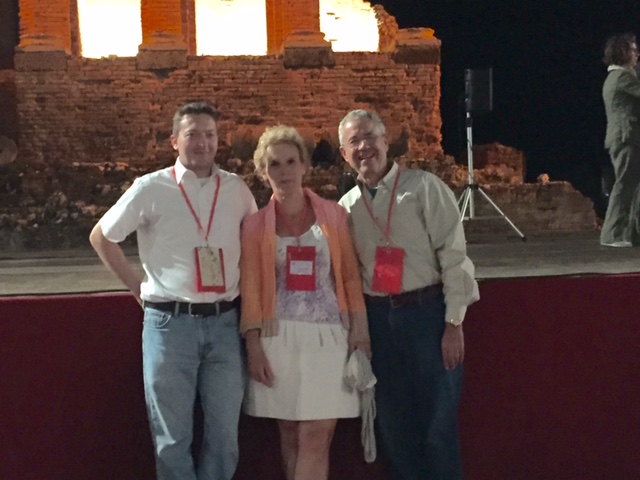 |
| From left: Me, Ute Wartenberg-Kagan (ANS), David Hendin (ANS), standing in front of the scaenae frons of the theater at Taormina. |
Wednesday, August 19, 2015
'Art in the Round': New Approaches to Ancient Coin Iconography
 In November 2012 an international workshop, 'Art in the Round': New Approaches to Ancient Coin Iconography, was held at the Eberhard-Karls-Universität Tübingen. At the end of 2014, the proceedings of that workshop were published: Elkins, N.T. and S. Krmnicek (eds.), 'Art in the Round': New Approaches to Ancient Coin Iconography. Tübinger Archäologische Forschungen 16. (Rahden: Verlag Marie Leidorf, 2014). Most participants were able to publish in the proceedings. Contributions explore different methods and approaches to ancient coin iconography and come from emerging and established scholars alike (Table of Contents here).
Permission was granted by the publisher to place the book's introduction online, which is available here and provides some description of the essays that follow. A kind summary of the book's contents was recently provided also by Dr. Ursula Kampmann of Coins Weekly.
Friday, July 3, 2015
Archaeological and Numismatic Book Seized from Islamic-State Militants Identified
In June it was reported that Kurdish fighters had seized some equipment from Turkish Islamic State Fighters in Syria and that among those items were archaeological and numismatic books. One book showed images of Phoenician coins. The photos of that book were blurry and it was difficult to identify the resource.
The mystery is now solved as Ute Wartenberg Kagan, Executive Director of the American Numismatic Society, recognized the open page in the photograph as from an essay in a book she had used before: M. Sartre, "La Syrie sous la domination achéménide," in W. Orthmann and J.-M. Dentzer, Archéologie et Histoire de la Syrie II (Saarbrücken, 1989). Compare photographs of the book seized from the militants and the same example in the ANS library (see more images here).
In discussing the identification of the book, she concludes:
The mystery is now solved as Ute Wartenberg Kagan, Executive Director of the American Numismatic Society, recognized the open page in the photograph as from an essay in a book she had used before: M. Sartre, "La Syrie sous la domination achéménide," in W. Orthmann and J.-M. Dentzer, Archéologie et Histoire de la Syrie II (Saarbrücken, 1989). Compare photographs of the book seized from the militants and the same example in the ANS library (see more images here).
 |
| 'New documents unravel ISIS-Turkish state cooperation’ (c) Mehmet Nuri Ekinci, Ajansa Nûçeyan a Firatê (ANF), 3rd June 2015 |
 | ||
| The book in the ANS Library. |
In discussing the identification of the book, she concludes:
"For people interested in a general overview of coins from Syria, this book is indeed helpful. Articles by Christian Augé on “La monnaie en Syrie à l’époque hellénistique et romaine” (pp. 149–190, with four plates illustrating 71 coins) and by Cécile Morrisson (who won the ANS Huntington Medal in 1995) on “La monnaie en Syrie byzantine” provide excellent and well-illustrated introductions to the coins of this region. Her article gives a considerable amount of detailed scholarly information on site finds of coins in Syria."
"So this is an extremely unlikely find—a scholarly, not exactly inexpensive, and heavy—book on the archaeology of Syria in the hands of ISIS fighters. If anyone doubts the multifaceted connections between looted antiquities and war in Syria, this discovery has to make one wonder." (emphasis added)
Saturday, May 30, 2015
The Tactics of a Dealers' Lobbyist
In the light of some recent posts and activities of IAPN's and PNG's lobbyist, Peter Tompa, who is also a member and representative of the ACCG, I have been considering his tactics again as I have witnessed them multiple times and commented on their apparent purposes in the past. It is perhaps worthwhile to survey some of those tactics here.
Personal Attacks. Personal attacks are often used as a substitute for engaging with the substance or accuracy of another party's comments. Users of personal attacks attempt to impugn another party's character, often with misleading or false commentary, so that they do not have to engage with and/or provide evidence to counter an argument or position. Peter Tompa has often used personal attacks as a tactic and frequently allows his compatriots to post personal attacks in the 'moderated' comments section of his blog. A recent example on Mr. Tompa's blog may be found here. He also is proud to count among his comrades the outspoken ACCG leadership; they have consistently made particularly repulsive attacks against organizations and individuals who advocate preservation, characterizing them as fascists, Nazis, or similar to terrorist organizations. A summary of some of these repugnant remarks is available in my 2012 article on the North American trade in ancient coins (pp. 100-104).
Dismissal/Denigration. A common component of personal attacks include the dismissal of one's credentials and/or the denigration of one's credentials by applying inaccurate labels. Academics who advocate preservation and sensitivity to looting issues are, therefore, often dismissed as "ivory tower" elitists. A recent example on Mr. Tompa's blog is found here (the post also contains a straw man). Like the personal attack, such dismissal evidently has as its aim to excuse not engaging with the evidence or argument of a different position (pointed out here). Mr. Tompa almost exclusively refers to preservationists like myself, David Gill, Paul Barford, Rick St. Hilaire, and others as "archaeobloggers," as if blogging is the only way our research and opinions are disseminated, and as if we do not have any other credentials and professions. Rick St. Hilaire is not even an archaeologist, but a lawyer and specialist in cultural properties! But Mr. Tompa does not like Rick St. Hilaire's insights and position on cultural property issues and so he gets called an "archaeoblogger," a label that the lobbyist and his friends use as a slur. In a recent post, Mr. Tompa has again referred to me as an "archaeoblogger and anti-trade advocate," in spite of the fact that I have rarely blogged for several years now. My occupation is that of tenure-track professor at a ranked research university. I teach and have authored numerous articles on ancient coins and coin iconography in addition to co-edited a book on coin iconography; a single-authored book will be in print by the end of the year. My research on the relationship between looting and coin trade in its current incarnation has also been published in several peer-reviewed outlets.
Deception. Deception is frequently another component of personal attacks or dismissal. After all, the ultimate effect or goal is to avoid formulating effective counter argumentation and presentation of fact-based evidence. For example, Mr. Tompa recently characterized me as an "anti-trade advocate." That is an incorrect characterization. Anyone may read for themselves what I have blogged in the past or what I have published. What I have consistently critiqued is the problematic relationship that the trade in its current incarnation has with looting and the illicit market in coins and antiquities. Mr. Tompa seeks to maintain a no-questions-asked status quo, evidently protecting business interests that wish to remain unconcerned when it comes to the sourcing of material! In fact, in my 2012 article, I suggest that a solution to obstruction posed by trade lobbying groups, which cater primarily to a dealer interest, is to circumnavigate them and engage directly with collectors (pp. 104-107). An "anti-trade advocate" would hardly suggest engagement with collectors. For an unvarnished riposte to the notion that preservationists are inherently "anti-trade," or as one unsightly comment on Mr. Tompa's blog that Mr. Tompa allowed (from a dealer known for hyperbole and personal attacks) suggests, "anti-science," see here.
The Straw Man. A common tactic is the straw man. By falsely attributing a statement or position to an individual and demolishing it, one does not engage with one's real position and makes the opposition appear foolish and absurd. In so doing, the user of a straw-man argument creates an imagined, inaccurate character. The straw man is a debate tactic often used in American political discourse. A popular example is Clint Eastwood's imaginary engagement with President Obama in an empty chair at the 2012 Republican National Convention, whereby he attributed positions to President that he does not hold and potential statements the President wold never make (some comments here and here).
In the comments section of one of his recent personal attacks against me, Mr. Tompa has claimed again that I have stated that Ptolemaic and early Roman period coins did not circulate out of Egypt (this all bears on the "first found in" argument that is part of the ACCG's test case). I posted a comment to that blog again asking him to substantiate the claim as I have never made it. Curiously, my comment was never posted. Maybe he never received it. Nonetheless, what I have said is that such coins tended to circulate primarily within Egypt as Egypt had a well-known closed currency system that promoted the retention of such coins. I have even published a Ptolemaic coin in the coin finds from Yotvata, Israel, although the site is very near the modern Egyptian border. So surely I would never state that no single Egyptian coin would never make it out of what is modern Egypt. Mr. Tompa's straw man claim is demonstrably false. It also curious that, in his own dealings with CPAC, he never acknowledged the well-known fact that Egypt had a closed currency system and that Ptolemaic and early Roman period Egyptian coins are primarily found in Egypt. Mr. Tompa attempts to distort my own position, which takes an honest account of the evidence, in order to distract from his own untenable position, which itself purposefully ignores decades of scholarship and common knowledge on coin circulation in Egypt.
Deflection/Innuendo. Sometimes one simply changes the subject or makes innuendo to distract from the question or issue at hand. So rather than presenting evidence to substantiate his straw-man claim that I apparently said Egyptian coins never traveled outside of Egypt, Mr. Tompa instead began making innuendos about "hidden" comments to the Cultural Property Advisory Committee. First of all, Mr. Tompa makes assumptions since he could not know if I submitted confidential comments to CPAC for any particular hearing or not. Secondly, the CPAC makes allowances for confidential comments to be submitted under certain circumstances where they could not be made publicly. If one submits confidential comments to CPAC, appropriately following the guidelines, the contents of those comments are no business of a trade lobbyist, especially one who chooses to engage in underhanded and slimy tactics. Finally, we see the purpose of deflection and innuendo: not only does he have me going on about a different subject now, attempting to distract me and his readers from his straw-man claim, he still has not substantiated his straw-man claim! He cannot, after all, substantiate a straw-man claim. By their very nature, straw-man claims are indefensible when you ask for substantiation and evidence.
Intimidation. Why does the lobbyist want access to comments that are potentially privileged or sensitive? No doubt he wants to spin and twist them on his blog, using the tactics above, in an attempt to intimidate into silence those with opinions different from his own. He has already criticized individuals with opinions different from his own for speaking at public hearings or submitting public comments to CPAC in the past. Mr. Tompa and his cohorts are well-known for using the tactics of intimidation. In the past they have communicated directly and secretly with colleagues of preservationists in attempt to impugn their reputations in the eyes of their colleagues and, worse, in an attempt to compromise their employment. I have a file documenting each attempt that is currently known to me.
Why? Why does Mr. Tompa use such tactics? One reason may be true ignorance of the issues or a misunderstanding of them. He is, for example, angry about an article I recently published that critiques the "first found in" argument presented in the ACCG's test case. Mr. Tompa dismisses the article as "obscure" and suggests the article is somehow "hidden" because it is published in a peer-reviewed print journal. David Gill points out how ill-informed the statement is that the journal is obscure and that the article is somehow hidden (here and here). Rather than expecting him to find the article for himself, the lobbyist is upset that I have not shared the article with him, although I shared it with colleagues. I explained to Mr. Tompa that the article cannot be placed for free, public download on a third-party website at this time owing to copyright issues and that I will not send him nor the lobby's founder an offprint as they are neither colleague nor collegial. He persists nonetheless. And this is not the first time that the lobbyist has behaved this way (for a response on the first episode, see David Gill's post). It is particularly troubling that Mr. Tompa does not seem to understand, at least in what he writes, how publication and research works (or evidently how to access a prominent archaeological journal in a library) since he himself is a legal professional and purports to represent dealers and collectors who claim to be independent scholars, who would necessarily conduct library research and publish in peer-reviewed journals.
But if the lobbyist and the organizations he represents are not truly ignorant of the issues and are not ill-informed about the evidence that is out there, why might he liberally use the tactics summarized here? Readers of the lobbyist's blog might take Mr. Tompa at his word and not follow up on original sources or explore for themselves the validity of his statements and arguments. Perhaps this convinces his constituency of the good work he does for them and for the organizations he represents. Perhaps there are other reasons, one of which may be the awkwardness of engaging with real evidence to advance his position or to counter the evidence-based position of preservationists. Fortunately, policy makers and researchers use more than blogs and tend to check sources and look for evidence and substance.
Update 5/31/2015. Mr. Tompa has responded to this post via a comment on his own blog. Interestingly, he does not link to my post so that readers can easily find it for themselves. It is more or less what I expected: further demands that I answer questions to satisfy his innuendo of a hidden conspiracy. There is no acknowledgement of wrongdoing on his part, no apology, and no substantiation of his recent straw-man claim (an impossibility after all). Interestingly, he seems, however, to acknowledge the deployment of underhanded tactics on his part by implying that whatever he does, it's okay because I have already done what I accuse him of; that, quelle surprise, is not substantiated. Indeed, I do not recall fabricating statements and attributing them to him (the straw man), nor do I recall me or my colleagues implying he or his compatriots are fascists or Nazis (a form of personal attack commonly used in ACCG quarters), nor do I recall trying to undermine his employment (intimidation) as he and his ACCG-friends have. We are all very aware of how you operate, Mr. Tompa. It is truly a pity that organizations have spent good money to support such a despicable and painfully transparent modus operandi. At least its transparency and lack efficacy will only hinder the cause to protect the damaging status quo.
Personal Attacks. Personal attacks are often used as a substitute for engaging with the substance or accuracy of another party's comments. Users of personal attacks attempt to impugn another party's character, often with misleading or false commentary, so that they do not have to engage with and/or provide evidence to counter an argument or position. Peter Tompa has often used personal attacks as a tactic and frequently allows his compatriots to post personal attacks in the 'moderated' comments section of his blog. A recent example on Mr. Tompa's blog may be found here. He also is proud to count among his comrades the outspoken ACCG leadership; they have consistently made particularly repulsive attacks against organizations and individuals who advocate preservation, characterizing them as fascists, Nazis, or similar to terrorist organizations. A summary of some of these repugnant remarks is available in my 2012 article on the North American trade in ancient coins (pp. 100-104).
Dismissal/Denigration. A common component of personal attacks include the dismissal of one's credentials and/or the denigration of one's credentials by applying inaccurate labels. Academics who advocate preservation and sensitivity to looting issues are, therefore, often dismissed as "ivory tower" elitists. A recent example on Mr. Tompa's blog is found here (the post also contains a straw man). Like the personal attack, such dismissal evidently has as its aim to excuse not engaging with the evidence or argument of a different position (pointed out here). Mr. Tompa almost exclusively refers to preservationists like myself, David Gill, Paul Barford, Rick St. Hilaire, and others as "archaeobloggers," as if blogging is the only way our research and opinions are disseminated, and as if we do not have any other credentials and professions. Rick St. Hilaire is not even an archaeologist, but a lawyer and specialist in cultural properties! But Mr. Tompa does not like Rick St. Hilaire's insights and position on cultural property issues and so he gets called an "archaeoblogger," a label that the lobbyist and his friends use as a slur. In a recent post, Mr. Tompa has again referred to me as an "archaeoblogger and anti-trade advocate," in spite of the fact that I have rarely blogged for several years now. My occupation is that of tenure-track professor at a ranked research university. I teach and have authored numerous articles on ancient coins and coin iconography in addition to co-edited a book on coin iconography; a single-authored book will be in print by the end of the year. My research on the relationship between looting and coin trade in its current incarnation has also been published in several peer-reviewed outlets.
Deception. Deception is frequently another component of personal attacks or dismissal. After all, the ultimate effect or goal is to avoid formulating effective counter argumentation and presentation of fact-based evidence. For example, Mr. Tompa recently characterized me as an "anti-trade advocate." That is an incorrect characterization. Anyone may read for themselves what I have blogged in the past or what I have published. What I have consistently critiqued is the problematic relationship that the trade in its current incarnation has with looting and the illicit market in coins and antiquities. Mr. Tompa seeks to maintain a no-questions-asked status quo, evidently protecting business interests that wish to remain unconcerned when it comes to the sourcing of material! In fact, in my 2012 article, I suggest that a solution to obstruction posed by trade lobbying groups, which cater primarily to a dealer interest, is to circumnavigate them and engage directly with collectors (pp. 104-107). An "anti-trade advocate" would hardly suggest engagement with collectors. For an unvarnished riposte to the notion that preservationists are inherently "anti-trade," or as one unsightly comment on Mr. Tompa's blog that Mr. Tompa allowed (from a dealer known for hyperbole and personal attacks) suggests, "anti-science," see here.
The Straw Man. A common tactic is the straw man. By falsely attributing a statement or position to an individual and demolishing it, one does not engage with one's real position and makes the opposition appear foolish and absurd. In so doing, the user of a straw-man argument creates an imagined, inaccurate character. The straw man is a debate tactic often used in American political discourse. A popular example is Clint Eastwood's imaginary engagement with President Obama in an empty chair at the 2012 Republican National Convention, whereby he attributed positions to President that he does not hold and potential statements the President wold never make (some comments here and here).
In the comments section of one of his recent personal attacks against me, Mr. Tompa has claimed again that I have stated that Ptolemaic and early Roman period coins did not circulate out of Egypt (this all bears on the "first found in" argument that is part of the ACCG's test case). I posted a comment to that blog again asking him to substantiate the claim as I have never made it. Curiously, my comment was never posted. Maybe he never received it. Nonetheless, what I have said is that such coins tended to circulate primarily within Egypt as Egypt had a well-known closed currency system that promoted the retention of such coins. I have even published a Ptolemaic coin in the coin finds from Yotvata, Israel, although the site is very near the modern Egyptian border. So surely I would never state that no single Egyptian coin would never make it out of what is modern Egypt. Mr. Tompa's straw man claim is demonstrably false. It also curious that, in his own dealings with CPAC, he never acknowledged the well-known fact that Egypt had a closed currency system and that Ptolemaic and early Roman period Egyptian coins are primarily found in Egypt. Mr. Tompa attempts to distort my own position, which takes an honest account of the evidence, in order to distract from his own untenable position, which itself purposefully ignores decades of scholarship and common knowledge on coin circulation in Egypt.
Deflection/Innuendo. Sometimes one simply changes the subject or makes innuendo to distract from the question or issue at hand. So rather than presenting evidence to substantiate his straw-man claim that I apparently said Egyptian coins never traveled outside of Egypt, Mr. Tompa instead began making innuendos about "hidden" comments to the Cultural Property Advisory Committee. First of all, Mr. Tompa makes assumptions since he could not know if I submitted confidential comments to CPAC for any particular hearing or not. Secondly, the CPAC makes allowances for confidential comments to be submitted under certain circumstances where they could not be made publicly. If one submits confidential comments to CPAC, appropriately following the guidelines, the contents of those comments are no business of a trade lobbyist, especially one who chooses to engage in underhanded and slimy tactics. Finally, we see the purpose of deflection and innuendo: not only does he have me going on about a different subject now, attempting to distract me and his readers from his straw-man claim, he still has not substantiated his straw-man claim! He cannot, after all, substantiate a straw-man claim. By their very nature, straw-man claims are indefensible when you ask for substantiation and evidence.
Intimidation. Why does the lobbyist want access to comments that are potentially privileged or sensitive? No doubt he wants to spin and twist them on his blog, using the tactics above, in an attempt to intimidate into silence those with opinions different from his own. He has already criticized individuals with opinions different from his own for speaking at public hearings or submitting public comments to CPAC in the past. Mr. Tompa and his cohorts are well-known for using the tactics of intimidation. In the past they have communicated directly and secretly with colleagues of preservationists in attempt to impugn their reputations in the eyes of their colleagues and, worse, in an attempt to compromise their employment. I have a file documenting each attempt that is currently known to me.
Why? Why does Mr. Tompa use such tactics? One reason may be true ignorance of the issues or a misunderstanding of them. He is, for example, angry about an article I recently published that critiques the "first found in" argument presented in the ACCG's test case. Mr. Tompa dismisses the article as "obscure" and suggests the article is somehow "hidden" because it is published in a peer-reviewed print journal. David Gill points out how ill-informed the statement is that the journal is obscure and that the article is somehow hidden (here and here). Rather than expecting him to find the article for himself, the lobbyist is upset that I have not shared the article with him, although I shared it with colleagues. I explained to Mr. Tompa that the article cannot be placed for free, public download on a third-party website at this time owing to copyright issues and that I will not send him nor the lobby's founder an offprint as they are neither colleague nor collegial. He persists nonetheless. And this is not the first time that the lobbyist has behaved this way (for a response on the first episode, see David Gill's post). It is particularly troubling that Mr. Tompa does not seem to understand, at least in what he writes, how publication and research works (or evidently how to access a prominent archaeological journal in a library) since he himself is a legal professional and purports to represent dealers and collectors who claim to be independent scholars, who would necessarily conduct library research and publish in peer-reviewed journals.
But if the lobbyist and the organizations he represents are not truly ignorant of the issues and are not ill-informed about the evidence that is out there, why might he liberally use the tactics summarized here? Readers of the lobbyist's blog might take Mr. Tompa at his word and not follow up on original sources or explore for themselves the validity of his statements and arguments. Perhaps this convinces his constituency of the good work he does for them and for the organizations he represents. Perhaps there are other reasons, one of which may be the awkwardness of engaging with real evidence to advance his position or to counter the evidence-based position of preservationists. Fortunately, policy makers and researchers use more than blogs and tend to check sources and look for evidence and substance.
Update 5/31/2015. Mr. Tompa has responded to this post via a comment on his own blog. Interestingly, he does not link to my post so that readers can easily find it for themselves. It is more or less what I expected: further demands that I answer questions to satisfy his innuendo of a hidden conspiracy. There is no acknowledgement of wrongdoing on his part, no apology, and no substantiation of his recent straw-man claim (an impossibility after all). Interestingly, he seems, however, to acknowledge the deployment of underhanded tactics on his part by implying that whatever he does, it's okay because I have already done what I accuse him of; that, quelle surprise, is not substantiated. Indeed, I do not recall fabricating statements and attributing them to him (the straw man), nor do I recall me or my colleagues implying he or his compatriots are fascists or Nazis (a form of personal attack commonly used in ACCG quarters), nor do I recall trying to undermine his employment (intimidation) as he and his ACCG-friends have. We are all very aware of how you operate, Mr. Tompa. It is truly a pity that organizations have spent good money to support such a despicable and painfully transparent modus operandi. At least its transparency and lack efficacy will only hinder the cause to protect the damaging status quo.


Tuesday, December 23, 2014
Support Graduate Students at the Huqoq Excavation Project in 2015
 If you're looking for an opportunity to support archaeology and directly impact students, here is a chance. The Huqoq Excavation Project is seeking donations with the target goal of $5,000 to support the travel of three graduate students (object specialists and assistant square supervisors) via experiment.com. To be successful, the target goal of $5,000 must be met in 35 days.
The excavations are exploring the remains of a Late Roman/Byzantine-era synagogue and an associated village. In the past several years, Huqoq has received wide coverage in the media for the discovery fine, colored mosaics in the synagogue, including the unprecedented appearance of a Greek king, perhaps Alexander the Great. For some discussion of the recent discoveries, see coverage in the Times of Israel.
Please consider donating today and directly affect students and archaeological study in a positive way. Click here to donate.
(Photo Credit: (c) Jim Haberman).
Friday, June 13, 2014
International Conference: Currency between Cultures
The international conference Currency between Cultures will be held at the University of Warwick on July 3, 2014.
Further information and registration is available here.
Though money is often characterised as an impersonal medium of exchange, it remains intricately connected to cultural value systems, social relationships, and political regimes. These characteristics are linked to the role of currency as a medium of commensuration designed to render equivalent and transitive once incomparable objects, ideas, signs, and meanings. In this way money goes ‘between’ cultures, and as a medium at the point of contact, money can often become ideologically charged. The eurozone, the rise of alternative currencies like Bitcoin, and the symbolic transformation of currencies during events like the Occupy movement ("We need a Revolution"), indicate that the social, ideological, and political aspects of money remain key modern concerns. This interdisciplinary conference aims to explore the differing ways money has connected, subverted, and entangled different cultures throughout history.
Further information and registration is available here.
Tuesday, May 27, 2014
New Research on Roman Republican Coinage
On June 19-21 in Dresden, Germany, an international colloquium on the topic of New Research on Roma Republican Coinage will be held. Many experts on Roman Republican coinage will present. In order of presentation, speakers include Andrew Burnett, Pierluigi Debernardi, Karl-Joachim Hölkeskamp, Maria Cristina Molinari, Pierre Assenmaker, Reinhard Wolters, David Biedermann, Bernhard Woytek, Florian Haymann, Wilhelm Hollstein, Clare Rowan, Martin Jehne, François de Callataÿ, Elio Lo Cascio, and Fleur Kemmers.
For the program with details for the venue and the subjects to be presented, click here.
For the program with details for the venue and the subjects to be presented, click here.
It's a Conspiracy!
The antics of the dealer lobby know no bounds. It is now being alleged by the group's lobbyist that numismatists in favor of the protection of ancient coins have ghost-written each others comments to CPAC. As absurd as the notion is, I suppose it is not unexpected from those quarters. Conspiracy theories are endemic among the dealer lobby's leadership, which is quite indicative of the desperation of their position.
And yes, there is something seemingly duplicitous in one lobby leader's acknowledgment of ancient Egypt's closed currency system before the lobby's founding, and then later pretending it did not exist when commenting on the potential MOU with Egypt. These intellectual changes of heart also speak to the desperation of their argument that coins do not merit or warrant protection.
Update, 5/27. Digging the hole deeper, the paid lobbyist, Peter Tompa, assumes I sent comments to CPAC on the potential MOU with Egypt and now demands that I make these presumed comments public. I am not sure who he thinks he is to make such demands. Nonetheless, whether or not I elected to exercise my right to make a comment is my decision alone and the CPAC allows comments to be submitted any number of ways.
He attempts to qualify his unusual interest in the matter: "CPO [Peter Tompa] does not question Elkins' (or anyone else's) rights to express their views to CPAC, just his unwillingness to let others assess for themselves their accuracy." I must say past actions do not bear this out. 1. The dealer lobby's leadership and its lobbyist do not rely on logic and facts to construct arguments, as the recent episode regarding circulation patterns in Egypt illustrates. 2. I recall multiple instances in which the dealer lobby (and yes, the lobbyist in question) have attempted to intimidate and perhaps even to undermine the employment of those who have voiced support for MOUs and advocated the protection of coins. And finally, it is not up to agenda-driven lobbyists to "assess for themselves the accuracy" of comments submitted to CPAC - that is up to the respective members of CPAC, appointed by the President.
And yes, there is something seemingly duplicitous in one lobby leader's acknowledgment of ancient Egypt's closed currency system before the lobby's founding, and then later pretending it did not exist when commenting on the potential MOU with Egypt. These intellectual changes of heart also speak to the desperation of their argument that coins do not merit or warrant protection.
Update, 5/27. Digging the hole deeper, the paid lobbyist, Peter Tompa, assumes I sent comments to CPAC on the potential MOU with Egypt and now demands that I make these presumed comments public. I am not sure who he thinks he is to make such demands. Nonetheless, whether or not I elected to exercise my right to make a comment is my decision alone and the CPAC allows comments to be submitted any number of ways.
He attempts to qualify his unusual interest in the matter: "CPO [Peter Tompa] does not question Elkins' (or anyone else's) rights to express their views to CPAC, just his unwillingness to let others assess for themselves their accuracy." I must say past actions do not bear this out. 1. The dealer lobby's leadership and its lobbyist do not rely on logic and facts to construct arguments, as the recent episode regarding circulation patterns in Egypt illustrates. 2. I recall multiple instances in which the dealer lobby (and yes, the lobbyist in question) have attempted to intimidate and perhaps even to undermine the employment of those who have voiced support for MOUs and advocated the protection of coins. And finally, it is not up to agenda-driven lobbyists to "assess for themselves the accuracy" of comments submitted to CPAC - that is up to the respective members of CPAC, appointed by the President.
Saturday, May 17, 2014
The CCPIA and the Circulation of Coins and Other Ancient Objects
The dealer lobby is irritated that people who have expertise on ancient coins have written in favor of a potential MOU with Egypt. One commentator and dealer is outright resentful that any specialist should support an MOU and goes so far as pronounce that the protection of coins in the MOUs is "extralegal."
The Convention on Cultural Property Implementation Act (CCPIA) mandates that protected objects be "first discovered in" the State Party. From the point-of-view of the dealer lobby, coins should not be protected since they circulated. They demand that it be proved beyond a doubt that each individual coin coming into the United States was found in a particular State Party, a task made nearly impossible when a coin is dug up, smuggled, cleaned, and sold by a dealer. The act of looting and smuggling destroys this information.
The dealer lobby asserts that coins are a special case since they "circulated widely" and are "common." But are they such an exception? Some coins circulated very widely and some circulated on a more local or regional level. Apart from static monuments, many ancient objects, in addition to coins, moved around to greater and lesser degrees. Ceramics are a prime example; they could circulate widely and they are "common." Even local wares are sometimes found far afield, although the majority are found locally. These, like circulating coins, are a testament to trade, economic conditions, and the movement of peoples and populations. The Etruscans were avid consumers of Greek painted pottery. The MOU with Italy protects Attic and Corinthian painted ceramics since these are frequently found in Etruscan tombs, even though they were made in Greece and can be found in other countries as well.
With Egyptian coins, the dealer lobby is reasserting the notion that coins "circulated widely" and should not be protected because they could be found anywhere. Yes, there are examples of Egyptian coins found outside of Egypt, but Egyptian coins are found primarily in Egypt. In contesting the potential protection of Egyptian coins, the desperation of their argument is apparent as they refuse to acknowledge long-standing scholarship on ancient Egyptian coins and Egypt's closed currency system, which caused Egypt to retain much of its currency in antiquity.
One commentator points to the Portable Antiquities Scheme database as evidence that Egyptian coins can be found as far away as England. Interestingly, what he does not acknowledge is that the majority of these are late Roman bronze coins from the mint of Alexandria; late Roman bronze coins have not been included in any MOUs thus far as they circulated widely and certainly they were not the subject of any comments sent to the Cultural Property Advisory Committee by advocates for the protection of coins. Again, that commentator refuses to acknowledge the closed currency system in Egypt and the fact that the majority of Egyptian coins will have been found in Egypt, just as a great many Attic and Corinthian ceramics will be found in Italy.
Finally, the protection of coins is extralegal only in the dealer lobby's opinion. Thus far, the lobby has been unsuccessful in undermining import restrictions in the courts. In fact, import restrictions on coins have been upheld by the courts as legal. In fact, the federal district court wrote:
Indeed, it would. And business as usual in the antiquities trade seems to be the intent behind the strategy.
Update, 517/2014: One lobbyist now insists that scholarly evidence cannot be produced that Egyptian coins are found in Egypt. I do look forward to a book from the lawyer/lobbyist that subverts decades of archaeological and numismatic understanding Egypt's closed currency system.
And apparently lobbyists/lawyers can declare what is legal and what is not - forget the courts. But I do not remember it working that way in civics class in grade school...
The Convention on Cultural Property Implementation Act (CCPIA) mandates that protected objects be "first discovered in" the State Party. From the point-of-view of the dealer lobby, coins should not be protected since they circulated. They demand that it be proved beyond a doubt that each individual coin coming into the United States was found in a particular State Party, a task made nearly impossible when a coin is dug up, smuggled, cleaned, and sold by a dealer. The act of looting and smuggling destroys this information.
The dealer lobby asserts that coins are a special case since they "circulated widely" and are "common." But are they such an exception? Some coins circulated very widely and some circulated on a more local or regional level. Apart from static monuments, many ancient objects, in addition to coins, moved around to greater and lesser degrees. Ceramics are a prime example; they could circulate widely and they are "common." Even local wares are sometimes found far afield, although the majority are found locally. These, like circulating coins, are a testament to trade, economic conditions, and the movement of peoples and populations. The Etruscans were avid consumers of Greek painted pottery. The MOU with Italy protects Attic and Corinthian painted ceramics since these are frequently found in Etruscan tombs, even though they were made in Greece and can be found in other countries as well.
With Egyptian coins, the dealer lobby is reasserting the notion that coins "circulated widely" and should not be protected because they could be found anywhere. Yes, there are examples of Egyptian coins found outside of Egypt, but Egyptian coins are found primarily in Egypt. In contesting the potential protection of Egyptian coins, the desperation of their argument is apparent as they refuse to acknowledge long-standing scholarship on ancient Egyptian coins and Egypt's closed currency system, which caused Egypt to retain much of its currency in antiquity.
One commentator points to the Portable Antiquities Scheme database as evidence that Egyptian coins can be found as far away as England. Interestingly, what he does not acknowledge is that the majority of these are late Roman bronze coins from the mint of Alexandria; late Roman bronze coins have not been included in any MOUs thus far as they circulated widely and certainly they were not the subject of any comments sent to the Cultural Property Advisory Committee by advocates for the protection of coins. Again, that commentator refuses to acknowledge the closed currency system in Egypt and the fact that the majority of Egyptian coins will have been found in Egypt, just as a great many Attic and Corinthian ceramics will be found in Italy.
Finally, the protection of coins is extralegal only in the dealer lobby's opinion. Thus far, the lobby has been unsuccessful in undermining import restrictions in the courts. In fact, import restrictions on coins have been upheld by the courts as legal. In fact, the federal district court wrote:
“[I]nterpreting the ‘first discovered in’ requirement to preclude the State Department from barring the importation of archaeological objects with unknown find spots would undermine the core purpose of the CPIA, namely to deter looting of cultural property. See 19 U.S.C. § 2602(a)(1)(A)” (p. 35)."The court further notes that the “ACCG’s argument, if taken to its logical conclusion, could bring into question the import restrictions on every, or almost every, item on the designated lists" (p. 36).
Indeed, it would. And business as usual in the antiquities trade seems to be the intent behind the strategy.
Update, 517/2014: One lobbyist now insists that scholarly evidence cannot be produced that Egyptian coins are found in Egypt. I do look forward to a book from the lawyer/lobbyist that subverts decades of archaeological and numismatic understanding Egypt's closed currency system.
And apparently lobbyists/lawyers can declare what is legal and what is not - forget the courts. But I do not remember it working that way in civics class in grade school...
Monday, May 12, 2014
Open-Access Publications (Numismatic, etc.) from the American School of Classical Studies at Athens
I have just heard from a colleague at the American School of Classical Studies at Athens that the publications committee recently voted to place ASCSA's out-of-print monographs on the Athenian Agora, Corinth, and the Hesperia supplements on its website. The publications have been made freely available in consultation with JSTOR, which provided the scans.
Some important references on coin finds in Greece are included and have been placed online.
Some important references on coin finds in Greece are included and have been placed online.
- Thompson, M. 1954. The Athenian Agora II: Coins from the Roman through the Venetian Period. (Princeton: The American School of Classical Studies at Athens).
- Miles, G.C. 1962. The Athenian Agora IX: The Islamic Coins. (Princeton: The American School of Classical Studies at Athens).
- Kroll, J. 1993. The Athenian Agora XXVI: The Greek Coins. (Princeton: The American School of Classical Studies at Athens).
- Edwards, K.M. 1933. Corinth VI: Coins, 1826-1929. (Princeton: The American School of Classical Studies at Athens).
Wednesday, January 15, 2014
Memorandum of Understanding with the Republic of Bulgaria Enacted, Coins Included in the Protective Measures
Bulgarian news agencies are reporting that the United States and the Republic of Bulgaria signed a Memorandum of Understanding to prevent the trafficking of looted and stolen cultural items.
Archaeologists, art historians, and academic numismatists had endorsed the MoU at the hearing of the Cultural Property Advisory Committee on 16 November 2011 (see here for a summary of comments). Commercial lobby groups in the United States and abroad have fought vigorously against the inclusion of ancient coins in Memoranda of Understanding. It is, therefore, notable that coins that primarily circulated in and are found in ancient Bulgaria are subject to protection.
The MoU with Bulgaria is momentous. This is the first Memorandum to protect some post-Classical coins as coins of the First Bulgarian Empire and Ottoman Empire are subject to restrictions. Most importantly, Bulgaria is one of the primary source countries for illicitly traded metal artifacts and ancient coins. Smuggled finds are imported and sold in the United States by the tens of thousands; the problem has been written about and studied extensively since the 1990s.
Bulgaria and the US signed on January 14 a memorandum of understanding on the protection of cultural heritage, meant to prevent the illicit trade of Bulgarian cultural heritage items and allow the return to Bulgaria of such items smuggled into the US.
The agreement was signed by US ambassador to Bulgaria Marcie B. Ries and Bulgaria’s Culture Minister Petar Stoyanovich at the National History Museum in Boyana.
The agreement authorises the US department of homeland security to prevent the import into the United States of Bulgarian cultural heritage items without a licence issued by the Bulgarian government and commits the US government to publish a list of prohibited items, which are to be seized unless the importer presents such a license.
The import restrictions will apply to a broad range of archaeological and religious items, as set forth in a designated list, to be published in the US Federal Register in the coming days, Ries said.
In addition to the import restrictions, the memorandum promotes further cooperation and information sharing between US and Bulgarian law-enforcement agencies.
“Of course this agreement will not eliminate the problem overnight. We recognise that and we also recognise that we must continue to work creatively together to preserve what we all recognise to be an invaluable cultural heritage. This agreement is of importance for its substance but also because it means more cooperation on a daily basis in the area of culture which is of importance to both Bulgarians and Americans,” Ries said.(From: "US, Bulgaria Sign Cultural Heritage Protection Memorandum," The Sofia Globe, January 14, 2014)
Archaeologists, art historians, and academic numismatists had endorsed the MoU at the hearing of the Cultural Property Advisory Committee on 16 November 2011 (see here for a summary of comments). Commercial lobby groups in the United States and abroad have fought vigorously against the inclusion of ancient coins in Memoranda of Understanding. It is, therefore, notable that coins that primarily circulated in and are found in ancient Bulgaria are subject to protection.
7. Coins – In copper, bronze, silver and gold. Many of the listed coins with inscriptions in Greek can be found in B. Head, Historia Numorum: A Manual of Greek Numismatics (London, 1911) and C.M. Kraay, Archaic and Classical Greek Coins (London, 1976). Many of the Roman provincial mints in modern Bulgaria are covered in I. Varbanov, Greek Imperial Coins I: Dacia, Moesia Superior, Moesia Inferior (Bourgas, 2005), id., Greek Imperial Coins II: Thrace (from Abderato Pautalia) (Bourgas, 2005), id., Greek Imperial Coins III: Thrace (from Perinthus to Trajanopolis), Chersonesos Thraciae, Insula Thraciae, Macedonia (Bourgas 2007). A non-exclusive list of pre-Roman and Roman mints include Mesembria (modern Nesembar), Dionysopolis (Balchik), Marcianopolis (Devnya), Nicopolis ad Istrum (near Veliko Tarnovo), Odessus (Varna), Anchialus (Pomorie), Apollonia Pontica (Sozopol), Cabyle (Kabile), Deultum (Debelt), Nicopolis ad Nestum (Garmen), Pautalia (Kyustendil), Philippopolis (Plovdiv), Serdica (Sofia), and Augusta Traiana (Stara Zagora). Later coins may be found in A. Radushev and G. Zhekov, Catalogue of Bulgarian MedievalCoins IX-XV c. (Sofia 1999) and J.Youroukova and V. Penchev, Bulgarian Medieval Coins and Seals (Sofia 1990).a. Pre-monetary media of exchange including “arrow money,” bells, and bracelets. Approximate date: 13th century B.C. through 6th century B.C.b. Thracian and Hellenistic coins struck in gold, silver, and bronze by city-states and kingdoms that operated in the territory of the modern Bulgarian state. This designation includes official coinages of Greek-using city-states and kingdoms, Sycthian and Celtic coinage, and local imitations of official issues. Also included are Greek coins from nearby regions that are found in Bulgaria. Approximate date: 6th century BC through the 1st century B.C.c. Roman provincial coins – Locally produced coins usually struck in bronze or copper at mints in the territory of the modern state of Bulgaria. May also be silver, silver plate, or gold. Approximate date: 1st century BC through the 4th century A.D.d. Coinage of the First and Second Bulgarian Empires and Byzantine Empire – Struck in gold, silver, and bronze by Bulgarian and Byzantine emperors at mints within the modern state of Bulgaria. Approximate date: 4th century A.D. through A.D. 1396.e. Ottoman coins – Struck at mints within the modern state of Bulgaria. Approximate date: A.D. 1396 through A.D. 1750.
(From the designated list).
The MoU with Bulgaria is momentous. This is the first Memorandum to protect some post-Classical coins as coins of the First Bulgarian Empire and Ottoman Empire are subject to restrictions. Most importantly, Bulgaria is one of the primary source countries for illicitly traded metal artifacts and ancient coins. Smuggled finds are imported and sold in the United States by the tens of thousands; the problem has been written about and studied extensively since the 1990s.
Tuesday, February 26, 2013
Huqoq 2013
The staff are gearing up for another season at Huqoq and the field school student applications are in. The 2012 season was most successful. What will 2013 hold for Huqoq Excavation Project?
The Baby and The Bathwater
Ever the provocateur, paid trade lobbyist Peter Tompa excels at the art of finding subjects to spin and snipe, even the most benign. The post here from February 17, 2013 summarizes an international conference on ancient coin iconography held last fall. Tompa muses ("Tail Wags Dog"):
The study of ancient coin iconography can be worked at multiple angles. Yes. So?
Anyone who read the summary or announcement of the workshop that was posted here should have understood that exploring the various ways that coin iconography can be approached was the whole point of the workshop. Tompa, it seems, would have us discard the importance of archaeological context simply because there are other ways that coin iconography can be studied too. If we are playing with tired idioms, forget about "tail wagging dog," Tompa would have us "throw out the baby with the bathwater"!
Tompa boldly claims "But all the workshop topics about coin iconography (including one Elkins himself chaired) simply belie this claim." Why the deception? Why ignore the fact that the workshop did include a session on "Coin Iconography in Numismatic and Material Contexts"? In case the session title is not clear, some papers in that session approached the study of coin iconography through the lens of find contexts (i.e. material context). For further clarification this means through hoards and/or archaeological excavation.
Coin iconography is, of course, not only worked at via find context and cannot be approached through material context alone, but to ignore its place in the workshop to promote one's own agenda is surely dishonest. And to imply that coin iconography cannot be approached through this route displays an ignorance of recent peer-reviewed research by several specialists on coin iconography that has appeared in-print within the last 5-10 years. The subject of Roman coin iconography is especially fruitful; our understanding of Roman imperial communication via the coins continues to be enhanced by attention to archaeological context.
It is simply wrong-headed to suggest that just because there are other ways of approaching subjects that other methods are irrelevant. We can read ancient historical texts that have survived the ages. Does that mean the study of art and archaeology is irrelevant? No. Art and archaeology can answer questions that texts cannot or can be deployed in conjunction with texts and other forms of evidence to reconstruct a more complete picture of the past.
The lobbyist's attempt at deception and sniping are characteristic of a debate that has become overly polarized, entrenched, and lacking of critical thought though rife with emotion. Would it not be better to acknowledge the importance of archaeological and material context and to seek ways in which both context and ethical collecting can be preserved so that avocational passion and scientific study can continue to coexist? More moderate and reflective voices must prevail.
The archaeological establishment has preached at CPAC meetings and elsewhere that coins—like other artifacts--lose all their meaning without context, and that import restrictions are necessary to encourage academic research. But all the workshop topics about coin iconography (including one Elkins himself chaired) simply belie this claim.
The study of ancient coin iconography can be worked at multiple angles. Yes. So?
Anyone who read the summary or announcement of the workshop that was posted here should have understood that exploring the various ways that coin iconography can be approached was the whole point of the workshop. Tompa, it seems, would have us discard the importance of archaeological context simply because there are other ways that coin iconography can be studied too. If we are playing with tired idioms, forget about "tail wagging dog," Tompa would have us "throw out the baby with the bathwater"!
Tompa boldly claims "But all the workshop topics about coin iconography (including one Elkins himself chaired) simply belie this claim." Why the deception? Why ignore the fact that the workshop did include a session on "Coin Iconography in Numismatic and Material Contexts"? In case the session title is not clear, some papers in that session approached the study of coin iconography through the lens of find contexts (i.e. material context). For further clarification this means through hoards and/or archaeological excavation.
Coin iconography is, of course, not only worked at via find context and cannot be approached through material context alone, but to ignore its place in the workshop to promote one's own agenda is surely dishonest. And to imply that coin iconography cannot be approached through this route displays an ignorance of recent peer-reviewed research by several specialists on coin iconography that has appeared in-print within the last 5-10 years. The subject of Roman coin iconography is especially fruitful; our understanding of Roman imperial communication via the coins continues to be enhanced by attention to archaeological context.
It is simply wrong-headed to suggest that just because there are other ways of approaching subjects that other methods are irrelevant. We can read ancient historical texts that have survived the ages. Does that mean the study of art and archaeology is irrelevant? No. Art and archaeology can answer questions that texts cannot or can be deployed in conjunction with texts and other forms of evidence to reconstruct a more complete picture of the past.
The lobbyist's attempt at deception and sniping are characteristic of a debate that has become overly polarized, entrenched, and lacking of critical thought though rife with emotion. Would it not be better to acknowledge the importance of archaeological and material context and to seek ways in which both context and ethical collecting can be preserved so that avocational passion and scientific study can continue to coexist? More moderate and reflective voices must prevail.
Sunday, February 17, 2013
'Art in the Round' a Sucess

The first two papers addressed theoretical approaches to coin iconography. Gunnar Dumke (Heidelberg) spoke on "Sekundäre Ikonographien. Prolegomena zu immobilisierten und imitierten griechischen Münztypen" and Dr. Ragnar Hedlund's (Uppsala) talk was entitled "‘Whose image is this’ - again? Exploring new frameworks for the interpretation of ancient coin imagery." In the afternoon, the lectures shifted focus to the study of coin iconography in both numismatic and material contexts. Dr. Clare Rowan (Warwick) began the session with her paper "Iconography in colonial contexts: the provincial coinage of the late Republic." Prof. Frank Daubner (Stuttgart) also spoke on provincial coins with his "Statische Bilder, statische Identitäten? Zu Münzdarstellungen römischer
Kolonien in Makedonien." Marta Barbato (Rome) delivered the fruits of her research on "Flavian typology: the evidence from the "sottosuolo urbano“ of Rome." Prof. Johannes Nollé's (Munich) talk compared Roman provincial coins in Asia with local inscriptions: "Kleinasiatische Lokalprägungen und Inschriften." Dr. Ute Wartenberg-Kagan (New York) took us on a stimulating methodological journey in her "The Clazomenae hoard: an archaeological and iconographical puzzle." And Prof. Lutz Ilisch (Tübingen) concluded our session by looking at the transformation of images across the centuries in "Zur Metamorphose der konstantinischen Victoria zum islamischen Schutzengel auf nordmesopotamischen Kupferdirham des 12. Jh."
The second day of the workshop was just as exciting as the first. In the morning session, papers zeroed in on specific iconographic types. Dr. Maria Cristina Molinari (Rome) spoke about meaning of early Roman coin iconography in her "The two Roman types with two-faced god on 3rd century BC coinage." Dr. Kyle Erickson (Lampeter) provided our only study on Hellenistic coinage: "Zeus to Apollo and back again: shifts in Seleucid policy and iconography." Mary Jane Cuyler's (Sydney) research "Portus Ostiensis on the Sestertii of Nero" dissected a well-known architectural image. Dr. David Wigg-Wolf (Frankfurt) reevaluated Christian symbolism on Constantinian coinage via his "Constantine’s silver medallion from Ticinum (RIC 36): 'one small step' o'a giant leap?'" The final session looked at coins through comparisons with texts and with other visual media. Christopher Simon's (Yale) "Etymology as image type in republican and imperial coinage" raised a great many questions about the meaning of republican coins, how the iconography worked with moneyers' names and how the viewer looked at republican coin iconography. Prof. Bernd Steinbock (Western Ontario) spoke on "Coin imagery and Latin panegyrics as means of imperial communication." Dr. Patrick Monsieur (Ghent), "The relationship between Greek coins, gems and pottery stamps: an introduction
through the archaeological evidence of Chios," provided an insights into the comparative world of amphora stamps and coin iconography. Prof. Martin Beckmann (McMaster) ended the day with his look at coins and portraiture in his "The relationship between numismatic portraits and marble busts: the problematic example of Faustina the Younger."
The organizers and participants agreed that workshop provided a series of formidable papers that opened the door for many fruitful discussions about how we study and interpret ancient coin iconography, as well as the potential for our various methods. The papers are currently being prepared for comprehensive publication in an edited volume.
Special thanks to Prof. Thomas Schäfer and the Institut für Klassiche Archäologie for opening their doors for this workshop.
Tuesday, July 24, 2012
Program: 'Art in the Round': New Approaches to Ancient Coin Iconography
The final program for the International Workshop 'Art in the Round': New Approaches to Ancient Coin Iconography, November 15-16, 2012 at the University of Tübingen, can now be circulated.
For more information and a printable program, please visit the conference website at
Thursday, 15 November 2012
10.00 Welcome and opening remarks
10.30 Keynote Address: Tonio Hölscher (Ruprecht-Karls-Universität Heidelberg), Historienbilder der römischen Republik: Das Repertoire der Münzen im Vergleich zu anderen Bildgattungen
Session I: Image and Theory
Chair: Fleur Kemmers (Goethe Universität Frankfurt)
11.30 Gunnar Dumke (Ruprecht-Karls-Universität Heidelberg), Sekundäre Ikonographien. Prolegomena zu immobilisierten und imitierten griechischer Münztypen
12.00 Ragnar Hedlund (Uppsala University), ‘Whose image is this’ - again? Exploring new frameworks for the interpretation of ancient coin imagery.
12.30 Lunch
Session II: Coin Iconography in Numismatic and Material Contexts
Chair: Stefan Krmnicek (Eberhard Karls Universität Tübingen)
14.00 Clare Rowan (Goethe Universität Frankfurt), Iconography in colonial contexts: the provincial coinage of the late Republic
14.30 Frank Daubner (Universität Stuttgart), Statische Bilder, statische Identitäten? Zu Münzdarstellungen römischer Kolonien in Makedonien
15.00 Marta Barbato (Università degli Studi di Roma La Sapienza), Flavian typology: the evidence from the "sottosuolo urbano“ of Rome
15.30 Coffee and tea
16.00 Johannes Nollé (Deutsches Archäologisches Institut), Kleinasiatische Lokalprägungen und Inschriften
16.30 Ute Wartenberg-Kagan (American Numismatic Society), The Clazomenae hoard: an archaeological and iconographical puzzle
17.00 Lutz Ilisch (Eberhard Karls Universität Tübingen), Zur Metamorphose der
konstantinischen Victoria zum islamischen Schutzengel auf nordmesopotamischen Kupferdirham des 12. Jh.
Session III: Type Specific Studies and the Importance of Coin Iconography
Chair: Nathan T. Elkins (Baylor University)
09.30 Maria Cristina Molinari (Musei Capitolini Roma), The two Roman types with the two-faced god on 3rd century BC coinage
10.00 Kyle Erickson (The University of Wales Trinity Saint David), Zeus to Apollo and back again: shifts in Seleucid policy and iconography
10.30 Mary Jane Cuyler (University of Sidney), Portus Ostiensis on the Sestertii of Nero
11.00 Coffee and tea
11.30 Richard Abdy (The British Museum), Trophy of the hunt: the Hadrianic introduction of the lion skin on coin portraits
12.00 David Wigg-Wolf (Deutsches Archäologisches Institut), Constantine’s silver medallion from Ticinum (RIC 36): “one small step” or “a giant leap”?
12.30 Lunch
Session IV: Coins, Literature, and the Visual Arts
Chair: Klaus Sachs-Hombach (Eberhard Karls Universität Tübingen)
14.00 Christopher Simon (Yale University), Image and etymology in republican coinage
14.30 Bernd Steinbock (University of Western Ontario), Coin imagery and Latin
panegyrics as means of imperial communication
15.00 Coffee and tea
15.30 Patrick Monsieur (Ghent University), The relationship between Greek coins, gems and pottery stamps: an introduction through the archaeological evidence of Chios
16.00 Martin Beckmann (McMaster University), The relationship between numismatic portraits and marble busts: the problematic example of Faustina the Younger
16.30 Concluding remarks and farewell
For more information and a printable program, please visit the conference website at
Programme
International Workshop
International Workshop
'Art in the Round': New Approaches to Ancient Coin Iconography
Eberhard Karls Universität Tübingen, Institut für Klassische Archäologie
15–16 November 2012
15–16 November 2012
Thursday, 15 November 2012
10.00 Welcome and opening remarks
10.30 Keynote Address: Tonio Hölscher (Ruprecht-Karls-Universität Heidelberg), Historienbilder der römischen Republik: Das Repertoire der Münzen im Vergleich zu anderen Bildgattungen
Session I: Image and Theory
Chair: Fleur Kemmers (Goethe Universität Frankfurt)
11.30 Gunnar Dumke (Ruprecht-Karls-Universität Heidelberg), Sekundäre Ikonographien. Prolegomena zu immobilisierten und imitierten griechischer Münztypen
12.00 Ragnar Hedlund (Uppsala University), ‘Whose image is this’ - again? Exploring new frameworks for the interpretation of ancient coin imagery.
12.30 Lunch
Session II: Coin Iconography in Numismatic and Material Contexts
Chair: Stefan Krmnicek (Eberhard Karls Universität Tübingen)
14.00 Clare Rowan (Goethe Universität Frankfurt), Iconography in colonial contexts: the provincial coinage of the late Republic
14.30 Frank Daubner (Universität Stuttgart), Statische Bilder, statische Identitäten? Zu Münzdarstellungen römischer Kolonien in Makedonien
15.00 Marta Barbato (Università degli Studi di Roma La Sapienza), Flavian typology: the evidence from the "sottosuolo urbano“ of Rome
15.30 Coffee and tea
16.00 Johannes Nollé (Deutsches Archäologisches Institut), Kleinasiatische Lokalprägungen und Inschriften
16.30 Ute Wartenberg-Kagan (American Numismatic Society), The Clazomenae hoard: an archaeological and iconographical puzzle
17.00 Lutz Ilisch (Eberhard Karls Universität Tübingen), Zur Metamorphose der
konstantinischen Victoria zum islamischen Schutzengel auf nordmesopotamischen Kupferdirham des 12. Jh.
18.30 Reception at the Museum of the University MUT | Ancient Cultures
Friday, 16 November 2012
Friday, 16 November 2012
Session III: Type Specific Studies and the Importance of Coin Iconography
Chair: Nathan T. Elkins (Baylor University)
09.30 Maria Cristina Molinari (Musei Capitolini Roma), The two Roman types with the two-faced god on 3rd century BC coinage
10.00 Kyle Erickson (The University of Wales Trinity Saint David), Zeus to Apollo and back again: shifts in Seleucid policy and iconography
10.30 Mary Jane Cuyler (University of Sidney), Portus Ostiensis on the Sestertii of Nero
11.00 Coffee and tea
11.30 Richard Abdy (The British Museum), Trophy of the hunt: the Hadrianic introduction of the lion skin on coin portraits
12.00 David Wigg-Wolf (Deutsches Archäologisches Institut), Constantine’s silver medallion from Ticinum (RIC 36): “one small step” or “a giant leap”?
12.30 Lunch
Session IV: Coins, Literature, and the Visual Arts
Chair: Klaus Sachs-Hombach (Eberhard Karls Universität Tübingen)
14.00 Christopher Simon (Yale University), Image and etymology in republican coinage
14.30 Bernd Steinbock (University of Western Ontario), Coin imagery and Latin
panegyrics as means of imperial communication
15.00 Coffee and tea
15.30 Patrick Monsieur (Ghent University), The relationship between Greek coins, gems and pottery stamps: an introduction through the archaeological evidence of Chios
16.00 Martin Beckmann (McMaster University), The relationship between numismatic portraits and marble busts: the problematic example of Faustina the Younger
16.30 Concluding remarks and farewell
Thursday, July 5, 2012
Synagogue Mosaic Revealed at Huqoq, Israel
 This summer I was in Huqoq, Israel where I am a staff member at the excavation of the ancient synagogue and village (I identify, record, and study the coin finds). This season I could only stay a week because of other obligations. While on site, I spent some time supervising the sifting operation and instructing field school students how distinguish various sorts of artifacts such as pot sherds, cut stone, glass, etc. from simple rocks. It was during this time that tiny tesserae (cube-shaped colored stones - the building blocks for mosaics) began to appear in great numbers in the sifter. This was an exciting indication that we would soon reveal a high-quality mosaic floor as the smaller the tesserae are, the finer the mosaic is. However, there were so many tesserae in the fill we also feared the mosaic floor may no longer be intact.
The mosaic floor discovered this summer relates to the Biblical story of Samson and a Hebrew inscription encourages readers to do good deeds. There have been several news articles online and an official press release from the Israel Antiquities Authority. Recently, CNN and MSNBC have also carried the news.
Here is an excerpt from the CNN article:
(CNN) -- Archaeologists are reveling in the discovery of an ancient synagogue in northern Israel, a "monumental" structure with a mosaic floor depicting the biblical figure of Samson and a Hebrew inscription.
The synagogue -- dating to the fourth and fifth centuries in both the Talmudic and late Roman periods -- is in Huqoq, an ancient Jewish village in the country's Galilee region, the Israeli Antiquities Authority said.
Jodi Magness, a professor of early Judaism in the Department of Religious Studies at the University of North Carolina at Chapel Hill, said the building was found in a recent excavation.
She called the find "exciting" and described the "very high quality of the artwork" in the mosaic, crafted with "tiny colored stone cubes." Only a few late Roman period synagogues contained mosaics with biblical scenes, said Magness, one of the leaders of a U.S., Israeli and Canadian team engaged in the digs.
"This discovery is significant," she said, calling the site "extraordinary" and "stunning."Samson was known for enormous physical strength and his fighting prowess against the Philistines, the enemy of the Israelites.
His story, recounted in the Bible's Book of Judges, mentions Delilah, a Philistine woman who worked to undermine Samson. She cut his hair after she persuaded Samson to reveal that his long hair was the secret to this strength.
Magness said the mosaic scene shows Samson putting torches between the tails of foxes. That image, from a vignette in the Book of Judges, is a reference to Samson exacting revenge on the Philistines by sending out flame-laden foxes to burn their lands.
She said the only other images of Samson in synagogues are at one nearby place in the Galilee known as Wadi Hamam, where Samson is seen "smiting" the Philistines with the jawbone of an ass. Another is in what is now modern Turkey, depicting scenes from Samson's life.
Click here to read the rest of the article.
Monday, April 30, 2012
Call for Papers: 'Art in the Round': New Approaches to Ancient Coin Iconography
International Workshop
University of Tübingen, Institut für Klassische Archäologie, 15–16 November 2012.
Organizers: Dr. Stefan Krmnicek, Eberhard Karls Universität Tübingen and Dr. Nathan T. Elkins, Baylor University
Call for Papers:
Our understanding of Graeco‐Roman coinage is
inextricably linked to the study of the images on those coins and the
messages that they conveyed. Designs on coins provide insights into the
nature of ancient visual culture and the societies in which such images
were deployed and consumed. Recent iconographic studies have
acknowledged that images on coins must be studied in concert with texts
and the material context of their bearers, requiring a new set of
interpretative methodologies and research agendas.
New research has demonstrated that by treating coin
images in the Greek and Roman worlds as a part of a semantic system and
by considering the archaeological evidence, we gain a better
understanding of the importance, meanings, and functions of images on
coins. As certain images appear to have been more or less relevant to
differing segments of society in different periods and across various
parts of the Mediterranean world, iconographic studies are also a unique
source of insight into political communication, and the socio‐cultural
identities of common people, individuals who otherwise left little or no
trace in the archaeological record.
Due to the existence of varied research traditions, the international workshop ‘Art in the Round’: New Approaches to Ancient Coin Iconography
aims to explore new directions in the study of iconography on
Graeco‐Roman coinage by gathering scholars from different academic
perspectives. Numismatists, Classicists, Historians, Archaeologists and
Art Historians are invited to present their research in order to
contribute to this timely topic. Papers that explore methodology or
specific topics or themes are welcome.
Abstracts of no longer than 300 words should be sent by email to
Stefan.Krmnicek(at)uni‐tuebingen.de and Nathan_Elkins(at)baylor.edu.
Deadline for submission is 30 June 2012. Papers in English and German are welcome.Conference website: http://www.uni-tuebingen.de/artintheround
Visit the conference website to download a printable copy of the Call for Papers. Colleagues are encouraged to circulate the Call for Papers among faculty, scholars, researchers, and graduate students who may wish to contribute to the workshop.
Tuesday, January 31, 2012
International Conference Call for Papers: Coinage, Minting, and Monetary Circulation in Antiquity and in the Middle Ages
I have been asked to publicize this call for papers for a numismatic conference at the University of Debrecen, Hungary. The conference will be held April 26-27, 2012.
The Department of History, the History Doctoral Program and the Department of Classics and Ancient History at the University of Debrecen (Hungary) are organizing a conference on ancient and medieval coins, coinage, mints and minting, money circulation and in a broader sense of finances and monetary systems, financial-economic measures, regulations, dues and customs, tolls, taxation etc. The conference is expecting papers from the periods of the use of money, from the fields of the emergence of money in certain periods as well as different aspects of financial-economic history. The conference has a dual thematic scope, awaiting papers both from ancient historians and medievalists.
If you wish to deliver a paper, please submit a title and a short summary of 100 words by March 1, 2012 and send an abstract of 2,500 words in English/German by April 2, 2012 to the following email address: pforisek2@yahoo.com. Inquiries may be directed to Péter Forisek at the same email address.
The organizers will offer free accommodation and meals for the two days of the conference.
Subscribe to:
Posts (Atom)