Showing posts with label Roman Empire. Show all posts

Friday, October 2, 2015

XVth International Numismatic Congress - Taormina, Sicily

I am still fighting jet lag from my recent trip to Italy where, among other things,  I participated in the XVth International Numismatic Congress in Taormina, Sicily from 21-25 September.  It was great to have my paper scheduled in the first session on the first day of the Congress so that the pressure was off and I could better enjoy talking to old colleagues, meeting new friends, and hearing about all the great research going on in numismatics.

The Congress happens once every six years and so it is a major event.  There were approximately 700 attendees, over 400 of whom also delivered papers.  Maria Caltabiano and Mariangela Puglisi are owed praise for the organization of the Congress.

The time in Sicily at the Congress was spectacular and there is too much to summarize in detail, although there were a few highlights for me.

On the first day I picked up the Survey of Numismatic Research and the Congress Medal (that will now sit alongside my medal from the 2009 Congress in Glasgow; here's my summary of that Congress - the time has flown by!). The Survey is a monumental work and I enjoyed reading the entries on Roman numismatics as well as Dan Pett's "Numismatics, Computers and the Internet." Some colleagues, Maria Cristina Molinari and Cristian Gazdac, generously gave me copies of their recent books.  I also picked up a few books on Roman coin iconography of which I had been unaware until I saw them in the exhibit hall.

In addition to the full academic program, there are numerous social events, receptions, and meals at the Congresses.  The ANS held a reception in honor of BCD and in memory of Richard Witschonke, both of whom were the honorands of books containing essays on Greek and Roman numismatics, respectively.  I got to take home my copy of P.G. van Alfen, G. Bransbourg, and M. Amandry (eds.), Fides: Contributions to Numismatics in Honor of Richard B. Witschonke. (New York: American Numismatic Society, 2015).  Rick read drafts of the essays prior to his passing.  He was always a generous, affable, and humble colleague and his presence at the Congress was sorely missed by all who knew him.

On the last evening was the social dinner, which for me was the last opportunity to speak with friends and colleagues before we all went our separate ways the next day.
Social Dinner. From right to left: Ethan Grueber (ANS), David Hill (ANS), Elena Stolyarik (ANS), Me (Baylor), Andrew McCabe (Independent Scholar/Collector), David Hendin (ANS), and I'm sorry that I cannot remember the names of the three people on the other side of the table whom I met for the first time at the dinner. (© MünzenWoche/CoinsWeekly).

Meeting new people and meeting people whose work you have read before is always one of the most exciting things at the Congress; there was, of course, much opportunity for this.  I was happy to meet many new people and several established numismatists as well rising starts in the field.  I regularly read the Coins Weekly newsletter and it was also great to meet the people who run that operation at their booth at the Congress.  They recently summarized their experiences at the Congress as well.
Ursula Kampmann took pictures with each of Coins Weekly's readers who stopped by the booth. (© MünzenWoche/Coins Weekly).

The Congress was certainly a worthwhile event and if you missed this one, I recommend the next one.  The next Congress will be in Warsaw in 2021; it will be organized by Aleksander Bursche.  I look forward to seeing everyone again then, but hopefully also before then.

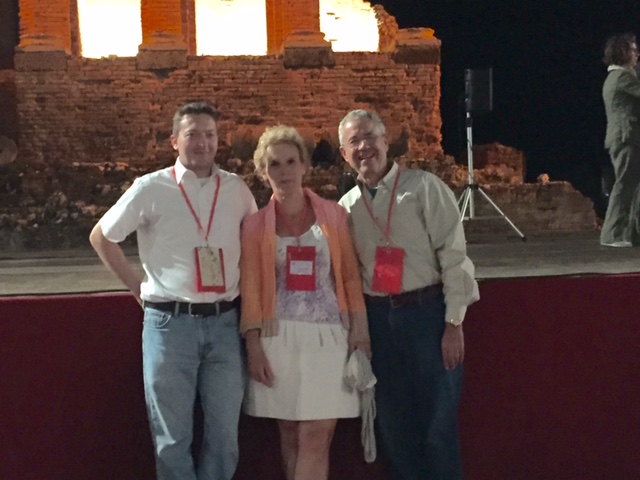
From left: Me, Ute Wartenberg-Kagan (ANS), David Hendin (ANS), standing in front of the scaenae frons of the theater at Taormina.

Wednesday, August 19, 2015

'Art in the Round': New Approaches to Ancient Coin Iconography

In November 2012 an international workshop, 'Art in the Round': New Approaches to Ancient Coin Iconography, was held at the Eberhard-Karls-Universität Tübingen.  At the end of 2014, the proceedings of that workshop were published: Elkins, N.T. and S. Krmnicek (eds.), 'Art in the Round': New Approaches to Ancient Coin Iconography. Tübinger Archäologische Forschungen 16. (Rahden: Verlag Marie Leidorf, 2014).  Most participants were able to publish in the proceedings.  Contributions explore different methods and approaches to ancient coin iconography and come from emerging and established scholars alike (Table of Contents here).

Permission was granted by the publisher to place the book's introduction online, which is available here and provides some description of the essays that follow.  A kind summary of the book's contents was recently provided also by Dr. Ursula Kampmann of Coins Weekly.

Sunday, July 5, 2015

Shepard Fairey and Roman Art

Aside from one upper-level course in Greek or Roman art history per semester, I also teach the Art History survey sequence: Prehistory to Medieval Art in the fall and Renaissance to Contemporary Art in the spring.  Even though my specialty is Antiquity, I find the second half of the survey is somehow more enjoyable to teach.  Maybe it is because I am not as "close" to it and can allow myself to have more fun with the subject when teaching.  One of my favorite artists to teach in the second half of the survey is Shepard Fairey, whose art I have also recently begun to collect.  I find the students also enjoy learning about him as they recognize his work in popular culture and wear Obey shirts (they are often thrilled to learn what Obey on their shirts is about as many don't already know).  As I work in a department driven primarily by a studio art program, a significant number of my survey students are graphic design majors.  One of the many hats that Shepard Fairey wears is that of a graphic designer; that is perhaps another reason the students enjoy seeing Fairey's work as he is an artist who has foot in both fine art and design. 

So what does the Shepard Fairey, of Obey Giant fame, who received worldwide recognition for his iconic "Hope" poster of Senator Obama during the 2008 primary - now one of the most famous and parodied images of the early 21st century, - have to do with Roman art?  Nothing really, except that my own work on Roman imperial art and coinage may explain why this contemporary artist and his artwork resonate with me.  I explain below.

Shepard Fairey, Hope, 2008, preceded by Progress, 2008.
Much of Fairey's work, especially his signed and numbered serigraphs are relatively affordable; they sell from roughly $45-$65 on his website if you can get them immediately as they are released.  The price point is intentional as Fairey wants his fans to be able to afford his work.  Older prints, or ones that you miss during a release, are available for a markup in the secondhand market.  The rarity of and demand for the print in question dictates the degree of that markup.  Over the past year, I have begun collecting Shepard Fairey's serigraphs and have thus far acquired eight prints and many books about his art. I plan to continue to grow the collection.  Two of these prints are quite rare and historical: "Progress" from 2008 (edition of 350), which contained the same iconic image as "Hope" print/poster, of which half a million posters were printed.  The "Progress" preceded that iconic, nearly identical, "Hope" image.  After the release of "Progress", the campaign adopted the image, asking Fairey to use the word "Hope" instead as a campaign poster.  As an art historian and archaeologist, the historic and documentary quality of the "Progress" piece particularly appealed to me.  It is an original print of one of the most recognizable images of the early 21st century, a part of our contemporary popular culture. The other print, "War: Everyone Wants It" from 2003 (edition of 200) is biting critique of the Iraq War, begun in 2003, through both image and text.  Although both are rare and desirable prints among collectors, I think I was able to acquire both of these historical pieces at reasonable prices - an important consideration for an academic.

Shepard Fairey, Pay Up or Shut Up, 2015.
For one recent acquisition, I was lucky to have beaten the notorious "eBay flippers," who purchase Fairey prints and immediately put them on eBay for two or three times the purchase price, and buy directly from Obey: "Pay Up or Shut Up" (2015, signed and numbered edition of 450).  This print depicts Uncle Sam's hand - his identity evident from the patriotic decoration on the sleeve of his suit - covering the mouth of a gentleman in a suit and tie, thereby silencing him.  At the top left, the text reads "All the Free Speech Money Can Buy."  At the lower right of the image is the Obey Giant logo and the title "Pay Up or Shut Up."  The print critiques the Citizens United supreme court decisions regarding Super PACs and donors to them.  The effect of this, as Fairey and others have described it, is the equation of money with speech and influence as politicians benefiting from wealthy PACsand donors will be unduly influenced by corporate and commercial interests.  The combination of text image points out the need for campaign finance reform to maintain legitimate democracy.  The sloganeering and fonts recall American 1950s-era advertisements that seem innocent enough on the surface, but from a 21st-century perspective many of these old advertisements smacked of racism or sexism, or cutely peddled dangerous products, such as cigarettes.


Shepard Fairey, Farewell to Freedom, 2014. 

Beyond mid-20th advertisements, Fairey's work clearly draws influence and inspiration from multiple artists, movements, and popular art media.  Perusing through a gallery of his works, one readily observes the influence of Social Realism, and especially Socialist Realism, in many of his pieces.  As a politically-minded artist, Fairey uses the visual cues of Socialist Realist imagery, accompanied by clearly ironical or satirical slogans, to point out dangerous flaws in contemporary American democracy that potentially corrode our democracy (I think he would say they do corrode that democracy) and put us on a path to autocracy and oligarchy, and/or corporatocracy.  Other works use the same visual style to exalt certain figures, such as freedom fighters and advocates for peace such as Aung San Suu Kyi. One recent piece deploying the style of Socialist Realism is "Farewell to Freedom" (signed and numbered edition of 500), an homage to comedian and political-news satirist Stephen Colbert of the recently-ended Colbert Report.  The slogan was also that of Colbert's last show. Stephen Colbert asked Shepard Fairey, previously a guest on the Report as well as a guest on the last show, to design the image for his final episode; signed and numbered prints were also released on the Obey Giant website.  In this example, the imagery seems to me to provide Colbert-inspired satire while the text may reflect Fairey's sentiment.  Stephen, using the American flag as a cape, stands to the left in a three quarter pose, one leg striding forward with his foot resting upon a globe; he does not engage the viewer but looks up confidently as if a resolute and transcendent figure (not unlike portraits of Alexander the great with the dramatically twisted neck and upturned eyes - a feature curiously enough observable in the "Hope"/"Progress" image).  In his right hand he wields a sword and in his left he holds a round shield - not dissimilar to Captain America's shield - as an eagle soars in the background.  The image of Stephen Colbert as a sort of authoritarian, transcendent, and god-like individual draws upon historical images of monarchs and from Socialist Realism, but parodies them.  On the Colbert Report, Stephen's unbreakable persona of the consummate egoist and fiercely uncompromising politically partisan pundit sharply satirized political news-show hosts on 24-hour cable-news networks.  The image, therefore, was a fitting tribute to the persona Stephen Colbert had adopted.  The text, "Farewell to Freedom," used in jest by the Colbert Report, reinforced the humorous notion that the political pundits on 24-hour cable-news networks actively present themselves as patriotic defenders of democracy who drape their one-sided opinions in the flag; Colbert's departure from the show thus signifies a certain "end" to freedom.  Nonetheless, the "Farewell to Freedom" print perhaps conveys something more sentimental in that Stephen Colbert's biting satire, but strong substance, was perceived by the artist and by many others as more honest and penetrating than that of the news-channel pundits that his show skewered.

Shepard Fairey, These Parties Disgust Me, 2010.
Even though Fairey is generally unpopular among political conservatives, he, like Stephen Colbert, criticizes both Republicans and Democrats, looking beyond partisanship to examine the function and dysfunction of the organs of American democracy itself, and American society more broadly; he has criticized President Obama several times since the election (a recent example here).  While one might disagree with Fairey's position on certain issues, those literate in art ought to to appreciate his work.  I mean "appreciate" in the sense of what "art appreciation" means (i.e., there is a difference between liking it on the one hand and appreciating/understanding it on the other).  Fairey's art and its sharp indictments of the political establishment are not only activist statements themselves, but also are reflective of broader popular disappointment and discontentment with how the contemporary American political system and landscape has (d)evolved over the past couple of decades.  A 2010 print, "These Parties Disgust Me," criticizes the flawed two-party system, frustration with both major political parties, and the artist's sentiment that campaign finance reform may be an antidote.

What appeals to me about Fairey's work is the conscious propagandist quality of his work.  With text and image, and often in the style of an advertisement or Socialist Realist political posters, he directly takes on an issue to make a point, often challenging policies espoused, or even ignored, by the news media.  One might see his work as propaganda to counter propaganda.  Indeed, "Worldwide Propaganda Delivery" is an Obey Giant slogan. The Obey sticker campaign sought to make one aware of his environment and the things he sees (and perhaps hears); the Obey logo, visible on his works, imbues his art with a sense of the looming authoritarian and, in so doing, reminds the viewer to question and critically evaluate everything.

Now for the connection with Roman art, which attracts to me to Fairey's work, as I study the communicative aspects of Roman imperial art and especially the coinage.  Roman imperial art has often been described as "propaganda," although few historians of Roman art would use that description today as carelessly as we have in the past.  Propaganda has strong 20th-century connotations.  Immediately one may recall the imagery and messages disseminated by the authoritarian governments of Soviet Russia and Nazi Germany via highly organized and well-structured propaganda ministries.  The goal of propaganda is to persuade the people of the government's position or course of action and to garner their support.  Roman art was not propaganda in this sense.  First of all, the Roman state was nowhere near this organized in the dissemination of messages.  Secondly, the Roman emperor, although a monarch, was not the sort of absolutist dictatorial ruler as that of modern North Korea or of Nazi Germany.  Instead, the head of the Roman state maintained power by negotiating and cultivating positive symbiotic relationships with many important constituencies in the Roman Empire: the Senate, the plebs urbana, the armies and their commanders, and provincial elites.  Finally, state-sanctioned Roman imperial art was not formulated to persuade imperial subjects of the emperor's political agenda with the goal of changing attitudes.

What state-sanctioned imperial art did was to present the emperor in a positive light.  In many cases, official state-sanctioned images, as appeared on the coinage, may not have been formulated by the imperial court at all.  A prominent theory is that mint officials formulated the images and messages on the coins with the emperor foremost in mind as the primary audience.  In this scenario, much of Roman art was akin to contemporary poetry and panegyric which aggrandized and honored the emperor.  Indeed, contemporary imperial coinage and text often reflected the same ideals, indicating that they reflected the political rhetoric of the day.  Even if the goal of much of the official art and coinage was to flatter the emperor, it also was seen, used, and experienced by viewers throughout the Roman world and so the communicative aspects of art and coinage ought not to be dismissed even though it was not "propaganda" in our typical understanding of the world.  One of the best and most recent discussions of the differences between the modern word "propaganda" and the communicative aspects of Roman imperial art that I have read is in Carlos Noreña's, Imperial Ideals in the Roman West (Cambridge University Press, 2011), pp. 15-21.  On p. 18, Noreña makes reference to another scholar (Ellul) who distinguished between "agitation" and "integration" propaganda.  He summarizes as follows.
"While agitation propaganda seeks to change attitudes, according to Ellul's definition, integration propaganda seeks to bolster them.  The former is more visible and widespread, is often subversive, and bears 'the stamp of opposition,' while the latter aims instead at 'stabilizing the social body,' making it 'the preferred instrument of government.'  This distinction is useful, and helps to explain why the imperial regime ever bothered to communicate a set of ideals and values associated with the reigning emperor.  In general, there was not much in the way of agitation propaganda in the Roman imperial period.  During the high empire in particular, there was little need to change attitudes and - even more important - the actual mechanics of imperial communications would have made it almost impossible to do so.  That the regular, long-term dissemination of imperial ideals was instead intended, at least in part, to reinforce belief in the legitimacy of Roman imperial rule seems more plausible....But the official communication of imperial ideals by the central state necessarily entailed a positive valuation of imperial rule, which in turn entailed a degree of persuasion, even if only implicit.  Moreover, one of the media available to the imperial regime, the coinage, was particularly well suited to the slow, long-term diffusion of ideas upon which such integration propaganda depends.  As a preliminary conclusion, then, we may see the central state in idealizing the figure of the emperor through a set of ideals and values associated with him, was motivated at least in part by the goal of reinforcing the legitimacy of Roman imperial rule." 
Generally speaking, Fairey's prints in the early 2000s and today exhibit the sort of dissent that is hardly observable in Roman art.  Fairey understands his own work as a sort of propaganda, borrowing directly from propagandist media, such as Socialist Realist posters, to make his points.  One might then see his work as "agitation propaganda" as it seeks to make the viewer aware of problems with the official state-sanctioned narrative.  He exhibits what we seldom have record of in the Roman visual arts: resistance and reaction to the contemporary political rhetoric and culture.  Fairey also has a following who hold the same beliefs and values that he does and some of his pieces might also be seen as a sort of "integration propaganda" to which the official Roman imperial art media might have been more related; it would probably be a like-minded individual who would consume something like "Pay Up or Shut Up" or "Farewell to Freedom."  Although the signed and numbered prints are limited, he often makes unsigned and unnumbered pasters, like the "Hope" poster in 2008, that can be used to saturate the public with a message.  Like the imperial coinage, in which certain ideals were reinforced consistently over time, Fairey has also reinforced ideals and concepts through time, such as campaign finance reform; this has been a theme in much of his work for several years now.  What draws me intellectually to the study of Roman art and coinage is the fact that they are historical monuments that tell us about the regime's politics and ideals at a moment in time long ago.  They represent pictorially the way that the regime conceived of itself and projected itself (either in a direct or indirect way).  While having the feel of an official medium, Fairey's art is anti-establishment and criticizes perceived problems in our present democracy through autocratic and commercial imagery and styles.  Fairey makes art for the living, as the Romans did, but he advocates for progressive change and points out issues that potentially could compromise democracy or otherwise degrade our society.  But as the years pass, his work will, like those Roman objects, become the realm of history.  We or our successors will have the opportunity to see if his concerns were valid.  Some of his work has unquestionably already entered that historical realm.

I am well aware that at this stage I have only a perfunctory knowledge of this artist's work, but I plan to continue to learn.

Tuesday, December 23, 2014

Support Graduate Students at the Huqoq Excavation Project in 2015

If you're looking for an opportunity to support archaeology and directly impact students, here is a chance.  The Huqoq Excavation Project is seeking donations with the target goal of $5,000 to support the travel of three graduate students (object specialists and assistant square supervisors) via experiment.com.  To be successful, the target goal of $5,000 must be met in 35 days.

The excavations are exploring the remains of a Late Roman/Byzantine-era synagogue and an associated village.  In the past several years, Huqoq has received wide coverage in the media for the discovery fine, colored mosaics in the synagogue, including the unprecedented appearance of a Greek king, perhaps Alexander the Great.  For some discussion of the recent discoveries, see coverage in the Times of Israel.

Please consider donating today and directly affect students and archaeological study in a positive way. Click here to donate.

(Photo Credit: (c) Jim Haberman).

Wednesday, February 27, 2013

Shekel of Tyre on History Channel Series "Pawn Stars"

The American cable television channel the "History Channel" does not air as much actual documentary and historical content as it once did.  Instead, it has gone the more profitable route with reality TV shows like "Swamp People", "Ax Men", "Big Rig Bounty Hunters," etc.  Even worse when one does flip on the TV to find a documentary program airing it is often that damaging, pseudo-archaeological program "Ancient Aliens". The Learning Channel, the Discovery Channel, and to a somewhat lesser degree National Geographic, have similarly switched to focus on reality programing.

Nonetheless, "Pawn Stars" is one top-rated History Channel program with a strong following.  I too enjoy the program.  The series follows a Las Vegas pawn shop that buys items of historical or collectible interest.  Experts are often brought in to evaluate the authenticity of items and to appraise them.  Many items, but not all, are great rarities.

On Monday night, a new episode aired; one segment featured a gentleman who sold a shekel of Tyre to the owners of the Pawn Shop.  Scholars generally accept that the Tyrian shekel was the mode of currency used in the infamous transaction of the thirty pieces of Judas paid to Judas to betray Christ (Matthew 26:14-16).  The thirty pieces are mentioned again when Judas returned the money to the chief priests after being overcome with remorse (Matthew 27:1-10).

A recent article by Haim Gitler provides a great discussion on the identification of the thirty pieces of silver as the Tyrian shekels (H. Gitler, "The Thirty Pieces of Silver: A Modern Numismatic Perspective," in L. Travaini (ed.), Valori e disvalori simbolici monete. I trenti denari di Giuda (Rome, 2009), pp. 63-78).  Archaeological excavation has helped to confirm that Tyrian shekels are the best candidate for the medium of exchange in the biblical episode as they circulated widely in the area and period in question.

The Pawn Stars paid $1,600 for the coin. Anyone familiar with the market can attest they overpaid, especially in view of the coin's condition.  The Pawn Stars also immediately sent off the coin to be slabbed and graded, a phenomenon which is common in the collecting of modern U.S. and world coins, but which has been resisted in the ancient coin collecting community.  It is curious that an expert was not called in as is typical with most historical items featured in the series.  The overpayment and slabbing would suggest the Pawn Stars do not regularly deal with ancient coins, or at least that they do not cater to serious collectors.

After purchasing the coin, the Pawn Stars were visited by a detective.  The coin was apparently stolen, not by the seller featured in the episode, but by a previous possessor of the coin.  A local interview with the man featured in the episode, who bought it along with some other coins at an estate sale for a few hundred dollars, alludes to this: ""It was 2000 years old. I'm sure it was stolen at some point in time after 2000 years yeah."  Ultimately the pawn shop was able to keep the coin as the owner from whom the coin was stolen had been reimbursed by his insurance policy.


WDRB 41 Louisville - News, Weather, Sports Community


Sunday, February 17, 2013

'Art in the Round' a Sucess

The two-day international workshop "Art in the Round: New Approaches to Ancient Coin Iconography was a resounding success that featured sixteen speakers from eight countries across three continents.  The distinguished theoretician and historian of Roman art, Prof. Tonio Hölscher (Heidelberg), kicked-off the conference with his keynote address, "Historienbilder der römischen Republik.Das Repertoire der Münzen im Vergleich zu anderen Bildgattungen."

The first two papers addressed theoretical approaches to coin iconography. Gunnar Dumke (Heidelberg) spoke on "Sekundäre Ikonographien. Prolegomena zu immobilisierten und imitierten griechischen Münztypen" and Dr. Ragnar Hedlund's (Uppsala) talk was entitled "‘Whose image is this’ - again? Exploring new frameworks for the interpretation of ancient coin imagery."  In the afternoon, the lectures shifted focus to the study of coin iconography in both numismatic and material contexts.  Dr. Clare Rowan (Warwick) began the session with her paper "Iconography in colonial contexts: the provincial coinage of the late Republic."  Prof. Frank Daubner (Stuttgart) also spoke on provincial coins with his "Statische Bilder, statische Identitäten? Zu Münzdarstellungen römischer
Kolonien in Makedonien." Marta Barbato (Rome) delivered the fruits of her research on "Flavian typology: the evidence from the "sottosuolo urbano“ of Rome."  Prof. Johannes Nollé's (Munich) talk compared Roman provincial coins in Asia with local inscriptions: "Kleinasiatische Lokalprägungen und Inschriften."  Dr. Ute Wartenberg-Kagan (New York) took us on a stimulating methodological journey in her "The Clazomenae hoard: an archaeological and iconographical puzzle." And Prof. Lutz Ilisch (Tübingen) concluded our session by looking at the transformation of images across the centuries in "Zur Metamorphose der konstantinischen Victoria zum islamischen Schutzengel auf nordmesopotamischen Kupferdirham des 12. Jh."

The second day of the workshop was just as exciting as the first.  In the morning session, papers zeroed in on specific iconographic types.  Dr. Maria Cristina Molinari (Rome) spoke about meaning of early Roman coin iconography in her "The two Roman types with two-faced god on 3rd century BC coinage." Dr. Kyle Erickson (Lampeter) provided our only study on Hellenistic coinage: "Zeus to Apollo and back again: shifts in Seleucid policy and iconography." Mary Jane Cuyler's (Sydney) research "Portus Ostiensis on the Sestertii of Nero" dissected a well-known architectural image. Dr. David Wigg-Wolf (Frankfurt) reevaluated Christian symbolism on Constantinian coinage via his "Constantine’s silver medallion from Ticinum (RIC 36): 'one small step' o'a giant leap?'"  The final session looked at coins through comparisons with texts and with other visual media.  Christopher Simon's (Yale) "Etymology as image type in republican and imperial coinage" raised a great many questions about the meaning of republican coins, how the iconography worked with moneyers' names and how the viewer looked at republican coin iconography.  Prof. Bernd Steinbock (Western Ontario) spoke on "Coin imagery and Latin panegyrics as means of imperial communication." Dr. Patrick Monsieur (Ghent), "The relationship between Greek coins, gems and pottery stamps: an introduction
through the archaeological evidence of Chios," provided an insights into the comparative world of amphora stamps and coin iconography. Prof. Martin Beckmann (McMaster) ended the day with his look at coins and portraiture in his "The relationship between numismatic portraits and marble busts: the problematic example of Faustina the Younger."

The organizers and participants agreed that workshop provided a series of formidable papers that opened the door for many fruitful discussions about how we study and interpret ancient coin iconography, as well as the potential for our various methods.  The papers are currently being prepared for comprehensive publication in an edited volume.

Special thanks to Prof. Thomas Schäfer and the Institut für Klassiche Archäologie for opening their doors for this workshop.

Tuesday, July 24, 2012

Program: 'Art in the Round': New Approaches to Ancient Coin Iconography

The final program for the International Workshop 'Art in the Round': New Approaches to Ancient Coin Iconography, November 15-16, 2012 at the University of Tübingen, can now be circulated.

For more information and a printable program, please visit the conference website at

Programme
International Workshop
'Art in the Round': New Approaches to Ancient Coin Iconography
Eberhard Karls Universität Tübingen, Institut für Klassische Archäologie
15–16 November 2012

Thursday, 15 November 2012

10.00 Welcome and opening remarks

10.30 Keynote Address: Tonio Hölscher (Ruprecht-Karls-Universität Heidelberg), Historienbilder der römischen Republik: Das Repertoire der Münzen im Vergleich zu anderen Bildgattungen

Session I: Image and Theory
Chair: Fleur Kemmers (Goethe Universität Frankfurt)

11.30 Gunnar Dumke (Ruprecht-Karls-Universität Heidelberg), Sekundäre Ikonographien. Prolegomena zu immobilisierten und imitierten griechischer Münztypen

12.00 Ragnar Hedlund (Uppsala University), ‘Whose image is this’ - again? Exploring new frameworks for the interpretation of ancient coin imagery.

12.30 Lunch

Session II: Coin Iconography in Numismatic and Material Contexts
Chair: Stefan Krmnicek (Eberhard Karls Universität Tübingen)

14.00 Clare Rowan (Goethe Universität Frankfurt), Iconography in colonial contexts: the provincial coinage of the late Republic

14.30 Frank Daubner (Universität Stuttgart), Statische Bilder, statische Identitäten? Zu Münzdarstellungen römischer Kolonien in Makedonien

15.00 Marta Barbato (Università degli Studi di Roma La Sapienza), Flavian typology: the evidence from the "sottosuolo urbano“ of Rome

15.30 Coffee and tea

16.00 Johannes Nollé (Deutsches Archäologisches Institut), Kleinasiatische Lokalprägungen und Inschriften

16.30 Ute Wartenberg-Kagan (American Numismatic Society), The Clazomenae hoard: an archaeological and iconographical puzzle

17.00 Lutz Ilisch (Eberhard Karls Universität Tübingen), Zur Metamorphose der
konstantinischen Victoria zum islamischen Schutzengel auf nordmesopotamischen Kupferdirham des 12. Jh.

18.30 Reception at the Museum of the University MUT | Ancient Cultures

Friday, 16 November 2012

Session III: Type Specific Studies and the Importance of Coin Iconography
Chair: Nathan T. Elkins (Baylor University)

09.30 Maria Cristina Molinari (Musei Capitolini Roma), The two Roman types with the two-faced god on 3rd century BC coinage

10.00 Kyle Erickson (The University of Wales Trinity Saint David), Zeus to Apollo and back again: shifts in Seleucid policy and iconography

10.30 Mary Jane Cuyler (University of Sidney), Portus Ostiensis on the Sestertii of Nero

11.00 Coffee and tea

11.30 Richard Abdy (The British Museum), Trophy of the hunt: the Hadrianic introduction of the lion skin on coin portraits

12.00 David Wigg-Wolf (Deutsches Archäologisches Institut), Constantine’s silver medallion from Ticinum (RIC 36): “one small step” or “a giant leap”?

12.30 Lunch

Session IV: Coins, Literature, and the Visual Arts
Chair: Klaus Sachs-Hombach (Eberhard Karls Universität Tübingen)

14.00 Christopher Simon (Yale University), Image and etymology in republican coinage

14.30 Bernd Steinbock (University of Western Ontario), Coin imagery and Latin
panegyrics as means of imperial communication

15.00 Coffee and tea

15.30 Patrick Monsieur (Ghent University), The relationship between Greek coins, gems and pottery stamps: an introduction through the archaeological evidence of Chios

16.00 Martin Beckmann (McMaster University), The relationship between numismatic portraits and marble busts: the problematic example of Faustina the Younger

16.30 Concluding remarks and farewell

Thursday, July 5, 2012

Synagogue Mosaic Revealed at Huqoq, Israel

This summer I was in Huqoq, Israel where I am a staff member at the excavation of the ancient synagogue and village (I identify, record, and study the coin finds).  This season I could only stay a week because of other obligations.  While on site, I spent some time supervising the sifting operation and instructing field school students how distinguish various sorts of artifacts such as pot sherds, cut stone, glass, etc. from simple rocks.  It was during this time that tiny tesserae (cube-shaped colored stones - the building blocks for mosaics) began to appear in great numbers in the sifter.  This was an exciting indication that we would soon reveal a high-quality mosaic floor as the smaller the tesserae are, the finer the mosaic is.  However, there were so many tesserae in the fill we also feared the mosaic floor may no longer be intact.

The mosaic floor discovered this summer relates to the Biblical story of Samson and a Hebrew inscription encourages readers to do good deeds.  There have been several news articles online and an official press release from the Israel Antiquities Authority.  Recently, CNN and MSNBC have also carried the news.

Here is an excerpt from the CNN article:

(CNN) -- Archaeologists are reveling in the discovery of an ancient synagogue in northern Israel, a "monumental" structure with a mosaic floor depicting the biblical figure of Samson and a Hebrew inscription.

The synagogue -- dating to the fourth and fifth centuries in both the Talmudic and late Roman periods -- is in Huqoq, an ancient Jewish village in the country's Galilee region, the Israeli Antiquities Authority said.

Jodi Magness, a professor of early Judaism in the Department of Religious Studies at the University of North Carolina at Chapel Hill, said the building was found in a recent excavation.

She called the find "exciting" and described the "very high quality of the artwork" in the mosaic, crafted with "tiny colored stone cubes." Only a few late Roman period synagogues contained mosaics with biblical scenes, said Magness, one of the leaders of a U.S., Israeli and Canadian team engaged in the digs.

"This discovery is significant," she said, calling the site "extraordinary" and "stunning."
Samson was known for enormous physical strength and his fighting prowess against the Philistines, the enemy of the Israelites.

His story, recounted in the Bible's Book of Judges, mentions Delilah, a Philistine woman who worked to undermine Samson. She cut his hair after she persuaded Samson to reveal that his long hair was the secret to this strength.

Magness said the mosaic scene shows Samson putting torches between the tails of foxes. That image, from a vignette in the Book of Judges, is a reference to Samson exacting revenge on the Philistines by sending out flame-laden foxes to burn their lands.

She said the only other images of Samson in synagogues are at one nearby place in the Galilee known as Wadi Hamam, where Samson is seen "smiting" the Philistines with the jawbone of an ass. Another is in what is now modern Turkey, depicting scenes from Samson's life.

Click here to read the rest of the article.

Monday, April 30, 2012

Call for Papers: 'Art in the Round': New Approaches to Ancient Coin Iconography

International Workshop
 
University of Tübingen, Institut für Klassische Archäologie, 15–16 November 2012.

Organizers: Dr. Stefan Krmnicek, Eberhard Karls Universität Tübingen and Dr. Nathan T. Elkins, Baylor University

Call for Papers:

Our understanding of Graeco‐Roman coinage is inextricably linked to the study of the images on those coins and the messages that they conveyed. Designs on coins provide insights into the nature of ancient visual culture and the societies in which such images were deployed and consumed. Recent iconographic studies have acknowledged that images on coins must be studied in concert with texts and the material context of their bearers, requiring a new set of interpretative methodologies and research agendas.

New research has demonstrated that by treating coin images in the Greek and Roman worlds as a part of a semantic system and by considering the archaeological evidence, we gain a better understanding of the importance, meanings, and functions of images on coins. As certain images appear to have been more or less relevant to differing segments of society in different periods and across various parts of the Mediterranean world, iconographic studies are also a unique source of insight into political communication, and the socio‐cultural identities of common people, individuals who otherwise left little or no trace in the archaeological record.

Due to the existence of varied research traditions, the international workshop ‘Art in the Round’: New Approaches to Ancient Coin Iconography aims to explore new directions in the study of iconography on Graeco‐Roman coinage by gathering scholars from different academic perspectives. Numismatists, Classicists, Historians, Archaeologists and Art Historians are invited to present their research in order to contribute to this timely topic. Papers that explore methodology or specific topics or themes are welcome.

Abstracts of no longer than 300 words should be sent by email to
Stefan.Krmnicek(at)uni‐tuebingen.de and Nathan_Elkins(at)baylor.edu.

Deadline for submission is 30 June 2012. Papers in English and German are welcome.

Conference website: http://www.uni-tuebingen.de/artintheround

Visit the conference website to download a printable copy of the Call for Papers.  Colleagues are encouraged to circulate the Call for Papers among faculty, scholars, researchers, and graduate students who may wish to contribute to the workshop.

Thursday, July 22, 2010

Somerset Hoard Declared Treasure

The discovery of a hoard containing around 52,500 Roman coins from Somerset has been widely covered in the media. The PAS blog has presented some initial findings ("Metal-Detectorist Finds Largest Pot of Roman Coins in Britain").

Today, BBC News reported that the Coroner has formerly declared the Somerset Hoard treasure. It is hoped that the enough money will be raised for the Museum of Somerset to acquire the hoard. Initial estimates suggest it may cost about £1 million.

Tuesday, June 8, 2010

Major Discovery in Peril


The discovery of the source of the Aqua Traiana, an aqueduct built by Trajan for the city of Rome, was announced earlier this year. The physical remains of the aqueduct's source had been unknown until recently, but what is believed to be abbreviated representations of its castellum survives on bronze coins of Trajan with the legend AQVA TRAIANA.

Unfortunately, efforts at preserving and studying this important site further are now being jeopardized.

The Telegraph reports:

In January father and son team Edward and Michael O'Neill discovered the headwaters of the aqueduct, which was built by the Emperor Trajan, hidden beneath a crumbling 13th century church north of Rome.

A sophisticated example of Roman hydraulic engineering, the aqueduct, known as the Aqua Traiana, was inaugurated in 109AD and carried fresh water 35 miles to the imperial capital.

But since the discovery was publicised, the archeologists claim that the farmer on whose land it stands has begun a crude excavation of the site in the hope of finding valuable Roman treasure.

They claim to have photographic evidence that the owner has burned vegetation around the entrance to the underground grotto, cut down mature fig trees which are holding the fragile structure together with their thick roots and started to dismantle sections of masonry.

"It's a complete tragedy," Edward O'Neill told the Daily Telegraph. "He's doing some kind of treasure hunt.

"What is needed is an expert process by archeologists to preserve the site." Repeated telephone calls to the landowner, Davide Piccioni, went unanswered yesterday.

In an attempt to stop the alleged damage to the site, the O'Neills and two American archeologists – Prof Katherine Rinne of Virginia University and Prof Rabun Taylor of the University of Texas at Austin – have sent a letter to Italian heritage authorities.

They have called for urgent intervention in order to prevent the landowner from further damaging the site, which they say has been "completely transformed" in the last six months.

They have also complained that the farmer has closed off access to the site since the grotto and spring were discovered five months ago.

The mayor of the local town, Lucia Dutto, said she too was concerned. "We have asked the superintendent of archaeology to carry out an immediate inspection of the site, so that further interference can be prevented. But until that happens, we can do nothing because it is private property."

Monday, June 7, 2010

Gladiator Cemetery Found in Northern England?


From CNN:

Heads hacked off, a bite from a lion, tiger or bear, massive muscles on massive men -- all clues that an ancient cemetery uncovered in northern England is the final resting place of gladiators, scientists have announced after seven years of investigations.

The archeological dig has found "what may be the world's only well-preserved Roman gladiator cemetery," the York Archaeological Trust said.

Scientists have found 80 skeletons in the "unique" cemetery under the city of York, northern England, since 2003.

They announced their discoveries on Sunday, ahead of a documentary about the site due to air in Britain on June 14. This was one of two big archaeological developments, with Israeli scientists announcing the discovery of a huge cache of ancient religious objects.

They first thought the graveyard might contain the remains of criminals or political purges.

But that doesn't explain the teeth mark.

"One of the most significant items of evidence is a large carnivore bite mark - probably inflicted by a lion, tiger or bear -- an injury which must have been sustained in an arena context, " said Kurt Hunter-Mann, the lead archeologist on the dig.

"Nothing like them has ever been identified before on a Roman skeleton," said Michael Wysocki, who examined the remains in the forensic anthropology laboratory at the University of Central Lancashire.

He said the bite marks suggest the remains were of someone who fought as a gladiator.

"It would seem highly unlikely that this individual was attacked by a tiger as he was walking home from the pub in York 2,000 years ago," he said.

One arm was bigger than the other in many remains, the scientists found -- a suggestion that the men were gladiators who trained from a young age with a weapon in one hand.

Other clues include healed and unhealed weapon injuries, possible hammer blows to the head, and burial with "grave goods" such joints of meat or pottery -- a sign of respect.

It's not certain that the men were gladiators, Hunter-Mann cautioned.

"The research is continuing and we must, therefore, keep an open mind," the archeologist said.

But "almost all the individuals are male, very robust and mostly above average height -- features which would also be consistent with a gladiator interpretation. Many also have muscle attachment marks on their arm bones suggesting severe muscle stress," he said.

They also appear to come from all over the Roman empire, which straddled the Mediterranean for hundreds of years, starting more than 2,000 years ago.

"These are internationally important discoveries. We don't have any other potential gladiator cemeteries with this level of preservation anywhere else in the world," Wysocki said.

The skeletons are between 1,600 and 1,900 years old.

The most impressive grave was that of a tall man aged between 18 and 23, buried, probably in a coffin, in a large oval grave about 1,700 years ago. He had been decapitated by several sword blows to the neck, the scientists said.

Buried with him were what appear to have been the remains of substantial joints of meat from at least four horses -- that left behind 424 horse bones -- possibly consumed at the funeral, plus some cow and pig remains.

Other graves also had joints of horse, sheep or chicken, possibly remains of funeral feasts, the archeologists speculated.

The site was first discovered when archeologists probed an area scheduled for a housing development in 2003.

Also on Monday, Israeli archeologists announced the discovery of a huge cache of religious objects about 3,500 years old -- older than the Bible itself, and nearly twice the age of the Roman skeletons.

"It would appear that the vessels were used in a pagan cult that worshipped idols. During this period it was customary that each city had a temple of its own where special cultic vessels were used," said archaeologists Uzi Ad and Edwin van den Brink.

They include a vessel that was used for burning incense, a sculpted face of a woman that was part of a cultic cup used in dedicating a libation to a god, goblets and bowls with high bases and tableware that was intended for eating and drinking, the Israel Antiquities Authority said.

Thursday, October 15, 2009

The Amphitheater at Portus

CNN is publicizing the recent discovery of the amphitheater at Portus by the University of South Hampton. In addition to an online article, there is also a video (below). I was surprised to see a colleague of mine, Christina Triantafillou, interviewed while excavating at the site. Hello Christina!

I met Christina at an AIA meeting several years ago via other University of Missouri graduate students who knew her from Tufts. In our conversation it soon became apparent we had much in common. I discovered she went through the ANS seminar the year after I did and was working on some excavation or hoard finds from Carthage. Also my M.A. advisor at Reading, who afterwards received a post at Oxford, is her Ph.D. advisor there.

I look forward to the reports and publications on the amphitheater. Check out the CNN article and video.

Monday, October 12, 2009

Coin Hoards and the Population of the City of Rome

A new article considers estimates for the population of the ancient city of Rome based on the prevalence of coin hoards and suggests figures lower than have been provided before:

P. Turchin and W. Scheidel, "Coin hoards speak of population declines in ancient Rome," Proceedings of the National Academy of Sciences of the United States of America (5 Oct. 2009).

The article is available online, but one must pay a fee to access it or log in from an institutional library that subscribes to online access of the journal.

A summary of the article is provided by Science Daily.

Thursday, October 8, 2009

More on the Colosseum Sestertii

A shameless plug.

Since I started this website, I have received several inquiries about the Colosseum sestertii. Those individuals may be interested to know that a third article on the Colosseum sestertii will appear in Numismatic Chronicle 2009: N.T. Elkins, "What are they doing here? Flavian Colosseum Sestertii from Archaeological Contexts in Hessen and the Taunaus-Wetterau Limes (with an Addendum on NC 2006)."

This short article discusses five Colosseum sestertii that were produced through archaeological excavation at three different sites in the area around modern Frankfurt, Germany. What is peculiar is that the type is very rare (with only five obverse dies known and approximately 50 extant specimens) and so the number that has appeared in this tight geographical region of approximately 20 km is remarkable. In the article I make reference to other archaeological work on coin supply and circulation in the area and propose an historical explanation for the presence of these coins in a region where they would otherwise be unexpected. The short article will be followed by an addendum listing specimens that were missed or which have surfaced since the 2006 die study and catalogue ("The Flavian Colosseum Sestertii: Currency or Largess?"), as well as some additional references for previously catalogued specimens and corrigenda. No new dies or links have appeared.

This short article provides no great revelations, but may be of interest for those who are interested in the Colosseum sestertii or who would like the supplemental information for the more important article and die study from 2006.

I was contacted early in the summer by a production crew making yet another documentary on the Colosseum and they were interested in discussing evidence provided by the coin representations. They seemed most interested in the argument about the location of the imperial box, discussed in the first article ("Locating the Imperial Box in the Flavian Amphitheatre: The Numismatic Evidence"), though most readers will have recognized that the numismatic evidence was used more as a way at introducing some of the fundamental problems with the idea that the box was located on the southern side, a thought which seems to have been perpetuated since Lugli wrote it as an assumption in a few of his works. In most cases, I do not believe that coin representations were meant to be 100% faithful renderings of the monuments in question and am sceptical about many attempts to base reconstructions on numismatic evidence alone. If I recall correctly, the inquiry was for a British documentary and so if anyone sees discussion of the Colosseum sestertii or the location of the imperial box in some new British documentary, please do let me know!

End shameless plug.

Photo: Colosseum sestertius of Domitian for Divus Titus, AD 81. Münzkabinett der Staatlichen Museen zu Berlin, Objektnummer 18204487

Thursday, August 20, 2009

Roman Architectural Coin Types and "Audience Targeting": A Preview of the Talk in Glasgow

At the XIVth International Numismatic Congress, I will have the opportunity to speak about an important facet of my dissertation on Roman architectural coin types. The presentation in Glasgow is entitled "Interpreting Architectural Coin Types from Recorded Contexts: The Flavian and Trajanic Periods" and takes place Wednesday morning in the Roman session "Empire - Coin Types (1st-2nd Century)," a session which promises many intriguing topics from colleagues.

In recent years, studies of coin supply and coin circulation rooted in archaeological evidence have attested that Roman bronze coinage was sometimes supplied to certain regions or populations based on the designs that those coins bore. This has important ramifications for the study of Roman coin images, Imperial ideology, and even Roman art as a whole.

In light of these developments in the fields of numismatics and archaeology, I decided to consider the regional distribution of architectural coin types in my dissertation from the Flavian and Trajanic periods since the Flavians and Trajan in particular produced a number of varied architectural coin types.

In Glasgow I will summarize my methodology and the results of this case study. There are, in my view, some interesting results with regard to the distribution and comparative frequencies of denotative types (architectural representations celebrating the construction or reconstruction of a specific monument in Rome) and connotative types (architectural designs evoking broader ideals or historical events other than construction).

For obvious reasons I do not wish to publicize the full results of this unpublished research, but I would like to show one of my pie charts (illustrated) which represents the regional distribution of bronze coin types celebrating construction of the Aqua Traiana for Rome that is one of the more convincing examples my research has yielded for an architectural coin type to targeted the city of Rome. The chart has been adjusted to account for the varying sizes of the corpora from the five main sample areas (Rome, Veneto, Germany, Austria, and Slovenia).

I would appreciate comments and discussion either in advance of or after the XIVth INC.

This post is protected by a Creative Commons 3.0 License.

Thursday, July 30, 2009

Coins in Context I: P. Beliën, "From coins to comprehensive narrative? The coin finds from the Roman army camp on Kops Plateau at Nijmegen..."

The first three essays by von Kaenel, Elkins, and Krmnicek from Coins in Context I: New Perspectives for the Interpretation of Coin Finds composed the first series of articles on "methodological overviews." The next four articles are grouped in a section called "potential at site level." The first of those is Paul Beliën's "From coins to comprehensive narrative? The coin finds from the Roman army camp on Kops Plateau at Nijmegen: problems and opportunities" (pp. 61-80). It should be noted that the military camp on Nijmegen's Kops Plateau should not be confused for the legionary fortress on the Hunerburg whose coin finds have already been systematically studied and analyzed (see F. Kemmers. 2006. Coins for a Legion: An Analysis of the coin finds of the Augustan Legionary Fortress and Flavian canabae legionis at Nijmegen. Studien zu Fundmünzen der Antike 21 (Mainz: von Zabern)).

Beliën's contribution lays out his methodology for a study of the coin finds from the fort on the Kops Plateau, founded c. 12 BC and abandoned in AD 69 during the Batavian Revolt, which he is currently undertaking. The first eight pages provide the historical background which need not detain us here. The author then provides a short history of the excavations on the Kops Plateau on page 69. The site has been rather productive. Beliën states "By 1995, 42,000 features, 375,000 sherds, 35,000 fragments of brick and loam, 30,000 metal objects, 3,000 pieces of slag, and 4,668 coins were found. In addition to this, copious amounts of organic material were recovered, such as 62,000 animal and human bone fragments." As he indicates one of the problems in studying material from the Kops Plateau is that little has been published, which he attributes to the fact that much of the site was excavated before the Malta Convention (alt. Valetta Treaty) was enacted in 1992, which has a provision for regular publication and reports. But at least the complete coin lists were published in 2002 in FMRN 3.1.

Beliën begins delving into his methodological discussion on page 70. In studying the coins in context, his primary goals are to understand what processes were in place to supply coins to the Kops Plateau and if there is any significance to deposition patterns of the coin finds. He adds:

"When analysing the coins and their contexts, we must take into account the various factors that governed the deposition and loss of coins and the post-depositional processes that influenced the ways in which the coin complex was formed. The size of coins, the metal they are made of, their value (in the Roman period, as well as in modern times), the number of coins of a certain type or denomination in circulation on a site, the way they were used and the methods used during excavation, must all be considered" (p. 70).
The author also plans on conducting a "numismatic analysis" that at this stage will focus on AVAVCIA coins, countermarked coins, and "barbaric imitations" which he expects will be new sources of information and which perhaps also were produced locally. Beliën also supposes that Celtiberian and Gallic coins may provide information about the origins of the soldiers on the Kops Plateau. All of this taken together should provide insights into how the coin series here came to be and will no doubt open the door to chronological questions and raise further questions on the way coins were used by or supplied to different military units at different periods of time.

Beliën will also examine the coin finds in a regional context in order to determine what relationships between the camp and outlying settlements and sanctuaries may have had through the lens of the coin finds: "By making an inventory of the coin finds from the area and comparing the loss patterns, it should be possible to learn more about the nature of the monetary interaction between the Roman military at Nijmegen and the people living in the Batavian countryside, which could be considered a militarised zone at the time" (pp. 72-73). The author then formally discusses some geographical and chronological limits of his study which need not occupy us here since we are most interested in the broader methodology.

Pages 74-77 address the data set. There are 5,340 coins from the Kops Plateau which are available for study. Most coin finds come from disturbed contexts. So far, approximately 200 coins were recovered from undisturbed features and in sealed contexts associated with other datable objects. Although much of the total corpus is considered "stray finds," they will still be essential components of the broader study. Coins from private collections or in the Museum het Valkhof that were found by metal detectorists, and those from early 20th century excavations, are excluded since it is not known where on the Kops Plateau they were found. This reduces his sample to 4,483 coins and ten coin hoards from the Kops Plateau. Beliën is also cautious against using coins from collections since they have undergone a modern process of selection in order to enter a collection and do not represent the ancient reality of what was lost.

Beliën also notes that while certain parts of the site were thoroughly excavated, and in these a metal detector was used in every trench after every 10-15 cm of excavation to ensure that all coins and metal objects were recovered, other parts were not and so the sample he is using will only reflect what was occurring at certain parts of the site at certain time periods. Large parts of the Kops Plateau remain unexcavated, and other areas of the site have been vandalized by looters and the sample of coin finds further diminished.

The final section of the article is entitled "A research strategy." It begins by telling us how each coin will be photographed and put into a database. Initial research questions will focus on the AVAVCIA coins, countermarked coins, and the "barbaric imitations," as well as the Celtiberian and Gallic coins. After the systematization of the data, Beliën will consider archaeological contexts in conjunction with the numismatic data. A distinction is made between coins with coordinates and coins without coordinates. Those without coordinates are only known to have come from a specific trench, other spatial information regarding their features or layers in which they were embedded is lost. He explains, however, "If we use the coordinates of the centre of the trenches in which these coins were found, we can still use them for the analyses to get at least some idea about the general distribution of these coins on the site."

The coins with an exact find spot are divided into three further categories: 1) not from features, 2) from features, and 3) closed contexts. Those in the first category will be used in spatial distribution maps. He expects this may provide some information on the date and function of various parts of the forts. Those in the second category may provide information on the feature or, alternatively, the feature may provide information on the coins. For the final category, Beliën explains:

"After analysing the coins and the associated data and material from every closed context, it has to be established if patterns can be discerned in the distribution of certain coin types, countermarks, etc., over these archaeological contexts. This might tell us something about the date and function of coins and coin use as well as the contexts in which they were lost. The coins from post holes, for example, may provide us with some interesting information: Harry van Enckevort, one of the excavators, told the author that several denarii were found in post holes of the praetorium and it is quite likely that these were intentionally deposited there" (p.79).
After this work is done and all of the information on the coin finds and various features is collated, the comparative work with outlying and neighboring settlements can be undertaken and preliminary plan is sketched.

Sunday, July 12, 2009

Coins in Context I: St. Krmnicek, "Das Konzept der Objektbiographie in der antiken Numismatik"

Here is the third installment in the series of posts about the new book, Coins in Context I: New Perspectives for the Interpretation of Coin Finds. Stefan Krmnicek’s "Das Konzept der Objektbiographie in der antiken Numismatik" (pp. 47-59) discusses theoretical applications in numismatics, namely the concept of "object biography." It is the only contribution in the volume that is not published in English, though it is preceded by a short abstract in English (p. 47).

Coins are economic tools and are frequently studied from this single perspective in modern discourses but, just as today, objects can have multiple varying and simultaneous functions. This contribution examines the contemporary reception of ancient coins by exploring the different potential functions they had. The first section of the article "Die Grundlagen des modernen Fachverständnisses" (pp. 48-52) is a short historiographic discussion on the way that our understanding of ancient coins has been shaped by centuries of study. The end of the section introduces a discussion on how developing theories and perspectives in prehistoric archaeology have influenced Iron Age numismatics, especially in defining a dichotomy between ritual and non-ritual interpretations.

The rest of the relatively short contribution provides an example from Arrian’s Cynegeticus (32, 1-2) where coins take on a completely different function as ritual offerings and posits a hypothetical model illustrating how the meaning of a coin could have changed at different times in its "lifetime." As archaeologists and numismatists, we must be aware that in most cases the only function or meaning of a coin that we can recognize will be that from its final deposition, i.e. from its find context. Any meaning it had before its final deposition will, in most cases, be lost to modern observers.

It is argued that the foundations for a discussion on the value of theory in numismatics have been laid in studies on Iron Age coin finds, but such perspectives could be applied to other areas of ancient numismatics as well.

All current and future posts pertaining to this book can be easily found by the keyword "Coins in Context I."

Monday, June 22, 2009

Coins in Context I: N.T. Elkins, "Coins, contexts, and an iconographic approach for the 21st century"

The second contribution in H.-M. von Kaenel and F. Kemmers (eds.). 2009. Coins in Context I: New Perspectives for the Interpretation of Coin Finds. Studien zu Fundmünzen der Antike 23 (Mainz: von Zabern) is my article "Coins, contexts, and an iconographic approach for the 21st century" (pp. 25-46).

To provide some background, this article grows out of the methodology I developed for my dissertation, "Architectural Coin Types: Reflections of Roman Society," but which should have relevance to other studies on Roman coin images in light of recent developments in Roman numismatics.

After a short introduction that briefly compares and contrasts the general characteristics of Greek and Roman coin images, the article surveys the iconographic approach to ancient coins from the Renaissance to the 20th century in the context of wider developments in numismatic science. The study of coin images became more systematic after the 18th century with the development of corpora and type catalogues. Many studies in the Renaissance fancifully invented coin types that would depict certain mythological and religious figures and so the work of Eckhel in the 18th century, among others, helped weed out fact from fantasy and order our knowledge of what the ancients produced. Multidisciplinary approaches to ancient coin images were not very common until the mid- to late 19th and early 20th centuries when Greek coin images were commonly studied in comparison with relief sculpture and statuary. But the study of Roman coin images was less developed – a likely consequence of the prevailing view at the time that Roman art was merely a derivative and degenerate form of Greek art. In the early and mid 20th century, as Roman art was given more attention (see below), so too were Roman coin images by scholars such as Harold Mattingly, Andreas Alfoldi, Konrad Kraft, C.H.V. Sutherland, and many others. The study of Roman coin images at this time was rooted in the traditional study of ancient history and the reading of ancient texts. Common 20th century interpretations of Roman coins were as instruments of "propaganda," a term less frequently used because of its problematic and false connotations. The use of the term "propaganda" as ascribed to Roman art and coins corresponds with historical events in Europe leading up to, during, and after the Second World War.

By the mid 20th century, the study of Roman coin images was a beloved topic in numismatic research, but some scholars felt the methodology used was weak and felt that "fantastical" histories were being built on iconographic evidence alone. This sentiment prompted A.H.M. Jones to criticize the iconographic approach in his contribution to the Festschrift for Harold Mattingly in 1956. While few today would accept the notion that the iconographic study of coins is a fruitless exercise, credit must be given to Jones who prompted a methodological reevaluation within the discipline. A few years later Sutherland published a response to Jones which highlighted promising ways that Roman coin images could be studied in conjunction with other forms of evidence and the sorts of questions that scholars should ask of Roman coin images. Since the publication of Jones' and Sutherland's respective articles, several methodological treatises on the study of numismatic images have been published and have underscored the need for interdisciplinary study and a critical approach to the source material.

In light of recent researches on coin images, I then propose an interdisciplinary methodology for the study of coin images introducing three crucial themes that provide answer to different questions relevant to Roman coin images: "numismatic context," "art historical context," and "archaeological context." Together these three perspectives give us the broadest understanding of the way coin images functioned Roman society.

In the section on "numismatic context," I discuss the importance of attention to emissions and the role of die studies. All too often, images on Roman coin images are studied in isolation and sometimes even apart from the image on the other side of the coin. In order to understand the overall visual program of an emperor via the coinage it is therefore necessary to attend to the emission from which a coin comes. I draw an example from Neronian coinage: his sestertii showing the Claudian harbor at Ostia and the dupondii showing the Macellum Magnum are often featured in individual texts and especially books on architectura numismatica, discussed in terms of how these coins celebrate the construction of the respective monuments. However, if we look at the other coin types Nero was striking contemporaneously we also see bronze coins bearing images of Annona and Ceres or a congiarium. The overall visual program gives a fuller understanding of these architectural images: they comprise a group of types which emphasize the emperor's concern with the grain supply and the well-being of the people. In addition to the discernment of emissions based on titulature, die studies can also nuance our understanding of ancient emissions further. An example is provided by the first emission in Claudius' reign:
"A die study of Claudius' coins indicate that the emperor's first precious metal emission of AD 41/42 consisted of aurei and denarii showing him within the walls of the praetorian barracks or standing before a praetorian signifer, with the legends IMPER RECEPT and PRAETOR RECEPT, respectively, aurei and denarii with a representation of Pax Augusta and the accompanying legend PACI AVGVSTAE, and gold quinarii with a flying Victory holding an oak wreath and a shield inscribed OB C S. Independently, these types could be interpreted in various ways, but taken together in the context of the emission there is a unifying theme: the circumstances surrounding Claudius' accession. The first two types reference the role the praetorian guard played in his acclamation and were used as donativa to pay them, the quinarii honor his receipt of the corona civica and the clupeus virtutis in service to the citizens of Rome, and the PACI AVGVSTAE types reference a peaceful transition of power to the new princeps" (p. 32).

The article continues in surveying other potential applications for die studies with respect to iconographic questions. Die studies by Sarah Cox on the Temple of Concord sestertii of Tiberius and by Fred Kleiner on the Arch of Nero on Neronian sestertii show that the most detailed – and presumably the most "faithful" representations of these monuments – were those that were struck earliest and that later strikes were more abstract or less detailed, probably as a result of copying. All too often, scholars approach ancient coin images without a well developed numismatic methodology. An example is provided by a study in which Trajanic coins were employed in reconstructions of the Forum of Trajan. Here the reconstructions based on numismatic evidence were somewhat haphazard since the arguments revolved around what "most" coins show rather than a comprehensive die study. The reconstructions also did not take account of the conventions used by die engravers who produced architectural coin images and so the author read some depictions too literally, such as the number of columns on the coin representation of a temple. Any scholar who approaches Roman coin images must have some firm grounding in numismatic methods and an understanding of the die engraver's conventions.

Die studies may also have the potential to discern the occasions that necessitated the striking of coins, which may in turn have some bearing on the meaning of the images themselves. A study by H.-M. von Kaenel on Early Imperial coinage has suggested that peaks in the number of obverse dies occur in the same years that large building projects were underway in the city of Rome.

I conclude the section on numismatic context with a discussion of frequency. Certainly not all Roman coin types were equal in the sense that some are more common than others and it stands to reason that those that were produced more abundantly would have played a more dominant role in a visual program. Die studies have been used to calculate the frequencies of coin types in ancient reality, but this methodology has been critiqued by numismatists such as T.V. Buttrey since a number of factors could have affected the productivity of ancient die. Another method of determining frequency of types is through hoard analysis which has provided promising results. For example, Carlos Noreña employed this methodology in a study in which he "ranked" the imperial virtues and their importance through their frequency in precious metal hoards.

The section ends and introduces the next section on "art historical contexts":
"We cannot restrict our studies of coin types to individual depictions or certain categories without being aware of both the political and cultural history of the period and the other coins that were struck together and in circulation at the same time. A command of historical/textual evidence and a strong grasp of numismatic contexts and methodologies – especially regarding emissions, die studies, and frequencies – are essential for anyone who approaches the question of numismatic iconography. Coins are more than historical documents and economic tools: they are products of the societies that produced and used them. The images they bear were not produced in isolation of contemporary art historical trends and the state clearly used them as a medium for communication. In order to have a fuller appreciation of how representations on ancient coins can inform us about the ancient world, one must also examine the material in both art historical and archaeological contexts" (p. 35).

Centuries ago, images on ancient coins were used by antiquarians to illustrate history or myth, but in the 19th and 20th centuries the study of coin images became more critical and interdisciplinary in terms of the wider study of art history. Several scholars in the 19th century such as Karl Otfried Müller included coins along with other objects in their classification and definitions of style. Other examples are treated in some detail. Much of the literature of the 19th century in particular focused almost exclusively on Greek coin images and, as I have said, was an effect of the way Roman art was perceived at the time. An exception to this general trend, however, was in the study of Roman portraiture which was greatly advanced in the 19th century by attention to Roman coin images as in the monographs published by Johann Jakob Bernoulli between 1882 and 1894. Roman coin images gained much more attention in the 20th century:
"Alois Reigl laid the first critical theoretical and methodological foundations for the study of Roman art when he published his formalistic treatment of Late Roman art, Spätrömische Kunstindustrie, in 1901 (Vienna, reprinted and revised in 1927). Indeed, Riegl's contribution impacted the whole of art history and not just Roman art; for the first time art was viewed as a tool for understanding the society that produced it and drew the study of art away from simple aestheticism. Riegl understood that human society does not just experience art but actively produces art, and through this simple – but profound – methodological realization he coined the term Kunstwollen, expressing the notion that the form or style of art was dictated by a collective 'will', 'intent', or 'habit' that also drove contemporary social, political, and intellectual trends. While coins were not specifically treated in Spätrömische Kunstindustrie, Riegl's work set the study of art history on a new course, influencing the way that Roman art, and ultimately also Roman coins, would be viewed and approached by later scholars" (pp. 38-39).

After a quick look at some other developments in Roman art history in the mid 20th century, I move onto the current understanding of Roman art as a semantic system. In this theoretical framework, Roman coins play a significant role as communicative instruments and have been given much attention by pioneering theoreticians and scholars such as Tonio Hölscher and Paul Zanker. The section concludes after a few more pages of discussion on the semantic system in Roman art and the concentrated picture language (Bildsprache) on coins.

The next section addresses the importance of archaeological contexts in the study of Roman coin iconography. It focuses on some very recent and significant revelations yielded by an intensive study of the coin finds from the legionary fortress at Nijmegen, published by Fleur Kemmers in 2006. Among other things, her work demonstrated that that the Flavian legionaries at Nijmegen were regularly supplied with coins that bore militaristically-themed images. Her comparative analysis of finds from neighboring civilian settlements and from Rome clearly showed a much higher concentration of militaristic types in the fortress at Nijmegen in contrast to these other sample areas. The supply of these militaristically-themed types to Nijmegen was connected to the soldiers' payment. The section ends:
"Where Hölscher expounded the semantic nature and system of Roman coinage, and where scholars such as Noreña and Depeyrot have quantified and applied hierarchical semantic 'value' to individual types, Kemmers compared finds from a particular site to local and regional finds and discovered that the semantic system was more nuanced than we had previously thought and that a certain population was supplied – deliberately – with certain coin types relevant to its station in Roman society" (p. 43).

It is then argued that we can further advance the study of Roman coin images by studying the distribution of coins at a regional level in order to discern the specific audiences to which certain types may have been directed. Several resources are outlined in the article. For example, we have a strong corpus of coin finds from the Northwestern provinces and there are some important finds from Rome which have been published and also the large corpus of c. 70,000 coins from Rome that awaits publication, but which has already been frequently made available to scholars studying coin finds. The essay concludes:

"Roman coins are multifarious objects that served a number of functions during their 'lifetimes' millennia ago. As with the study of any other category of ancient art, the understanding of an ancient coin is broadened by the number of contexts to which we can relate it and, when this is done properly and critically, our knowledge of the ancient world is enhanced. For the historical and cultural contexts in which to place a Roman coin, one might turn to ancient texts and modern historical discourses. Traditional numismatic methods such as die studies, associating certain types with emissions, and quantifying the frequency of a particular type provide the numismatic context; these may allow one to 'rate' the semantic value of types in relation to one another and understand them in conjunction with wider ideological programs. The art historical context, namely approaching images on Roman coins as part of a semantic system, allows one to unpack the meaning of an image. Not the least of the contexts to consider is the material or archaeological context, which may allow researchers to define the audience to whom certain types were directed on regional and site-specific levels. It is no longer sufficient that iconographic studies on Roman coins be relegated purely to historical, art historical, or numismatic perspectives. The nature of the objects themselves demands a more comprehensive and multidisciplinary approach. Only in this manner, can one hope to use the source material to its greatest potential and fully appreciate the role numismatic imagery played in the Roman world" (p.46).

All posts relevant to the monograph containing this collection of essays can be found by using the keyword "Coins in Context I."